
Given below are two statements: Statement I: Hardwired control unit can be optimized to produce fast mode of operation. Statement II: Indirect addressing mode needs two memory reference to fetch the operand. In the light of the above statements. choose the correct answer from the options given below
Both Statement I and Statement II are true
Analyzing Computer Architecture Statements
Let's carefully examine each statement regarding computer architecture concepts: hardwired control units and indirect addressing mode.
Statement I: Hardwired Control Unit Optimization for Speed
Statement I says: Hardwired control unit can be optimized to produce fast mode of operation.
A hardwired control unit is a type of control unit that uses fixed logic gates and combinational circuits to generate control signals directly based on the instruction being executed and the current state of the CPU. The control signals are generated by complex logic circuits built using gates like AND, OR, NOT, NAND, NOR, etc. The sequence of operations is determined by the structure of these logic circuits.
Key characteristics of hardwired control units:
- Uses combinational logic.
- Control signals are generated directly.
- Execution speed is generally faster compared to microprogrammed control units because there is no need to fetch microinstructions from control memory.
- The logic circuits can be designed and optimized for speed by minimizing propagation delays through the gates. This optimization can indeed lead to a very fast mode of operation.
Therefore, the statement that a hardwired control unit can be optimized for fast operation is accurate.
Statement II: Indirect Addressing Mode Memory References
Statement II says: Indirect addressing mode needs two memory reference to fetch the operand.
In indirect addressing mode, the address field in the instruction does not contain the actual address of the operand. Instead, it contains the address of a memory location where the *actual address* of the operand is stored. To get the operand, the CPU must perform the following steps:
- First Memory Reference: Fetch the address contained in the instruction's address field from memory. This value is not the operand itself, but the location of the operand's address.
- Second Memory Reference: Use the address obtained in step 1 to fetch the actual operand from that memory location.
Consider an instruction with indirect addressing:
LOAD R1, (Address_A)
Here, Address_A is the address stored in the instruction. The parenthesis `()` typically indicate indirect addressing. The CPU performs the following:
- Go to memory location Address_A.
- Read the content at Address_A. Let's say this content is Effective_Address_B. This is the first memory reference.
- Now, Effective_Address_B is the actual address of the operand.
- Go to memory location Effective_Address_B.
- Read the content at Effective_Address_B. This content is the actual operand. This is the second memory reference.
- Load the operand into register R1.
Thus, fetching the operand using indirect addressing mode requires two distinct memory references.
Therefore, the statement that indirect addressing mode needs two memory references to fetch the operand is also accurate.
Conclusion
Based on the analysis:
- Statement I about hardwired control unit optimization for speed is true.
- Statement II about indirect addressing mode requiring two memory references is true.
Both statements are correct.
| Concept | Statement | Analysis | Truth Value |
|---|---|---|---|
| Hardwired Control Unit | Can be optimized for fast operation. | Uses combinational logic, faster than microprogrammed. Optimization of logic circuits enhances speed. | True |
| Indirect Addressing Mode | Needs two memory references to fetch the operand. | Instruction → Address of Operand Address → Operand Address → Operand. Requires two memory lookups. | True |
Revision Table: Control Units and Addressing Modes
| Feature | Hardwired Control Unit | Microprogrammed Control Unit | Indirect Addressing Mode | Direct Addressing Mode |
|---|---|---|---|---|
| Implementation | Combinational Logic | Control Memory (Microinstructions) | Instruction gives address of operand address | Instruction gives direct operand address |
| Speed | Faster | Slower (due to fetching microinstructions) | Slower (2 memory references) | Faster (1 memory reference) |
| Flexibility | Low (difficult to change instruction set) | High (easier to add/modify instructions) | Provides access to larger address space, enables position-independent code | Simpler, faster access |
| Design Complexity | Complex for complex instruction sets | Simpler for complex instruction sets | Adds complexity to instruction decoding and execution | Simpler |
| Memory References for Operand | N/A (Control Unit concept) | N/A (Control Unit concept) | 2 | 1 |
Additional Information: Computer Architecture Basics
Understanding control units and addressing modes is fundamental in computer architecture. Let's briefly touch upon related concepts.
- Control Unit: The control unit is a component of the CPU that directs the operation of the processor. It tells the computer's memory, arithmetic/logic unit and input/output devices how to respond to the instructions that have been sent to the processor.
- Microprogrammed Control Unit: This type of control unit uses a microprogram stored in a special control memory. Each instruction is executed by a sequence of microinstructions. This approach offers more flexibility for complex instruction sets but is generally slower than hardwired control.
- Addressing Modes: These are the different ways in which the location of an operand is specified in an instruction. Common addressing modes include:
- Immediate: The operand value is present directly in the instruction.
- Direct: The instruction contains the exact memory address of the operand. Requires one memory reference.
- Indirect: The instruction contains the address of the memory location that holds the address of the operand. Requires two memory references.
- Register: The operand is in a CPU register specified in the instruction. No memory reference needed.
- Register Indirect: The instruction specifies a register that contains the address of the operand. Requires one memory reference.
- Indexed: The operand address is calculated by adding a constant value (displacement) to the contents of an index register. Requires one memory reference (after calculation).
Choosing the appropriate control unit design and addressing modes impacts the performance, flexibility, and complexity of a computer system.
Important Questions from Data-Path and Control Unit
Which of the following statements with respect to multiprocessor system are true?
(A) Multiprocessor system is controlled by one operating system.
(B) In Multiprocessor system, multiple computers are connected by the means of communication lines.
(C) Multiprocessor system is classified as multiple instruction stream and multiple data stream system.
Choose the correct answer from the options given below:
The following program is stored in memory unit of the basic computer. What is the content of the accumulator after the execution of program? (All location numbers listed below are in hexadecimal).
Location
Instruction
210
CLA
211
ADD 217
212
INC
213
STA 217
214
LDA 218
215
CMA
216
AND 217
217
1234H
218
9CE2H
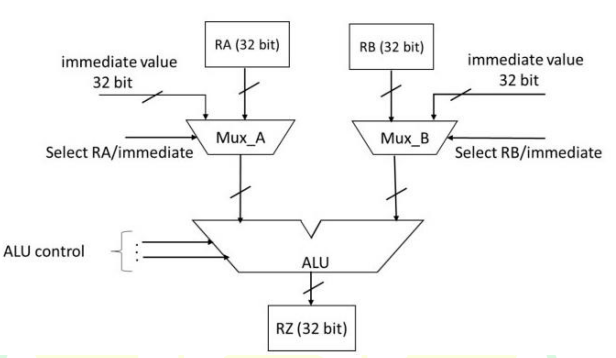
A partial data path of a processor is given in the figure, where RA, RB, and RZ are 32-bit registers. Which option(s) is/are CORRECT related to arithmetic operations using the data path as shown?
Given below are two statements: one is labelled as Assertion A and the other is labelled as Reason R
Assertion A: Instruction pipelining improves CPU throughput.
Reason R: Pipelining decreases the execution time of each individual instruction.
In the light of the above statements, choose the most appropriate answer from the options given below


