
The following electronic transistor circuit is analysed by using the DC values of IE, VE and VC which represent the emitter current, emitter voltage and collector voltage respectively. (Assume VBE = 0.7 V, Current gain β = 100) Considering these D.C. voltages, the collector-emitter voltage VCE is close to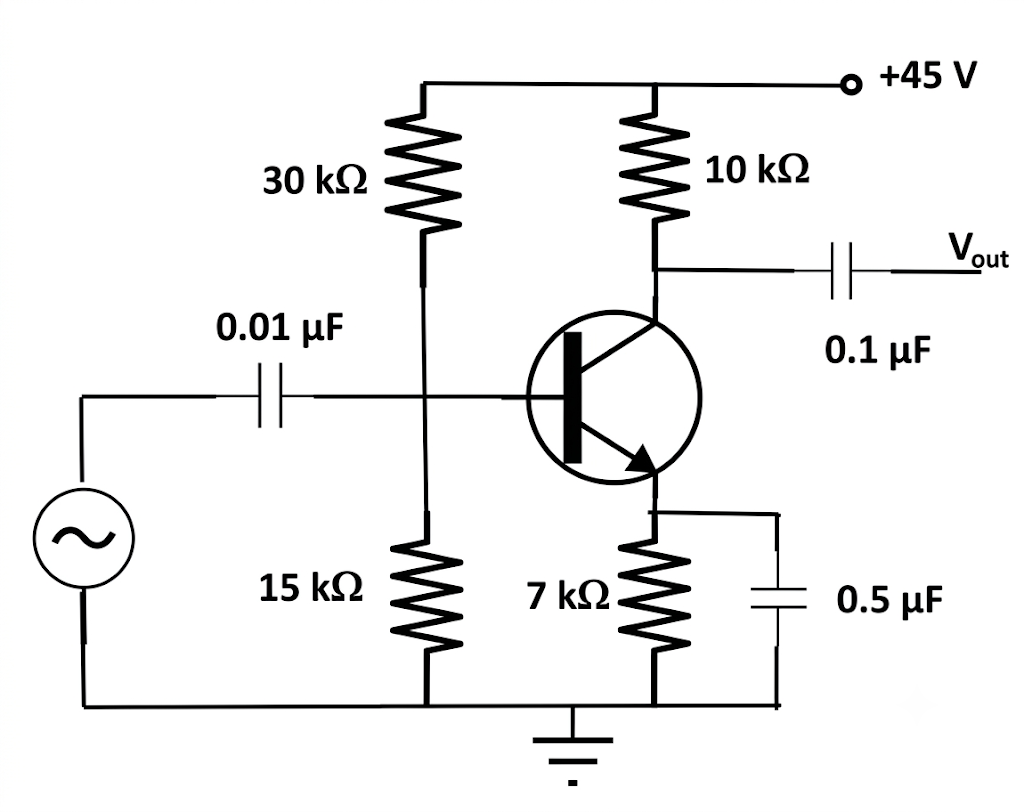
11 V
From the figure: VCC = +45 V, voltage-divider bias with R1 = 30 kΩ (to VCC) and R2 = 15 kΩ (to ground), collector resistor RC = 10 kΩ and emitter resistor RE = 7 kΩ (bypassed by 0.5 μF). For DC analysis all capacitors are open circuits.
Thevenin equivalent of the base divider: VTh = 45 × 15/(30 + 15) = 15 V and RTh = 30 kΩ ∥ 15 kΩ = 10 kΩ.
Base current: IB = (VTh – VBE)/[RTh + (β + 1)RE] = 14.3/(10 k + 101 × 7 k) = 14.3/717 k ≈ 19.9 μA.
Emitter current: IE = (β + 1)IB ≈ 2.01 mA, so VE = IERE ≈ 14.1 V; collector current IC = βIB ≈ 1.99 mA.
Collector voltage: VC = 45 – ICRC ≈ 45 – 19.9 ≈ 25.1 V.
Therefore VCE = VC – VE ≈ 25.1 – 14.1 ≈ 11.0 V. (The quick approximation VB ≈ 15 V, VE ≈ 14.3 V, IE ≈ 2.04 mA gives VCE ≈ 10.5 V, also closest to 11 V.)
Hence, the answer is 11 V.
Similar Questions
The value of the line integral \(I = \int \vec{A}\cdot d\vec{r}\), where \(\vec{r} = x\hat{i} + y\hat{j}\) and \(\vec{A} = (x+y)\hat{i} + (y-x)\hat{j}\), along the path \(y^{2} = x\) from the point \((1, 1)\) to the point \((4, 2)\) is:
A set \(V\) of complex numbers forms a two-dimensional real vector space under the usual addition of complex numbers and multiplication by real numbers. Let \(T : V \to V\) be a linear transformation defined as \(T(z) = \bar{z}\). Eigenvalues of \(T\) are:
It is given that the residue of the complex function \(\dfrac{e^{1/z}}{z^{n}}\) at an isolated singular point \(z = 0\) is \(\dfrac{1}{9!}\). The value of \(n\) must be equal to:
The Cauchy principal value of the integral \(\displaystyle\int_{-\infty}^{\infty} \dfrac{e^{2ix}\sin x}{x}\,dx\) is:
The function \(f(x) = \exp(2x)\sin(2x)\) can be expanded as the Taylor series:
The inverse Laplace transform of \(\dfrac{2s^{2}}{s^{4}+5s^{2}+4}\) is:
Consider the differential operator \(L=a\dfrac{d^{3}}{dx^{3}}+b\dfrac{d^{2}}{dx^{2}}+c\dfrac{d}{dx}\) acting on the space of functions \(\{u_{i}(x)\mid 1\le x\le 2\}\) satisfying the boundary conditions \(u_{i}(1)=0=u_{i}(2)\). If \(L=L^{\dagger}\), then:
A general solution of the partial differential equation \(\dfrac{\partial^{2} f(x, y)}{\partial x^{2}} - \dfrac{\partial^{2} f(x, y)}{\partial y^{2}} = 0\) can be expressed in terms of arbitrary functions \(u\) and \(v\) as:
The Wronskian of two solutions of the differential equation \(x^{4}\dfrac{d^{2}y(x)}{dx^{2}}-2x^{3}\dfrac{dy(x)}{dx}-x^{8}y(x)=0\) is (up to a multiplicative constant):
Let \(T\) be any \(2 \times 2\) matrix with eigenvalues \(-1, 3\). For each positive integer \(n\), the numbers \(a_n\) and \(b_n\) are such that \(T^{\,n+1} = a_n T + b_n I\), where \(I\) is the \(2 \times 2\) identity matrix. Then \(a_n\) and \(b_n\) satisfy the recurrence relations:
Important Questions from Mixed Topic (MH-SET)
.................... is a client server application that identifies each host on the internet with a unique user-friendly name.
Every OS has a ................ or .......... which primarily resides in the main memory of the computer to perform some of the basic functions of the OS.
(i) Kernel
(ii) Interface
(iii) Nucleus
(iv) Compiler
Codes:
Which of the following are referred to as low level language?
(i) Machine language
(ii) Assembly language
(iii) High level language
(iv) Natural language
Codes:
Match the following:
List I List II (a) New York Public Library (i) Shelv AR (b) Miami University Augmented Research Group (ii) Smart library (c) Oula University Library (iii) Wolf Walk (d) North Carolina State University (iv) Find the future Codes:
Which part of the QR code represents the encoded data?



