
Significance of Amniotic Egg in Reptile Evolution
The evolution of the amniotic egg was a pivotal adaptation for reptiles, fundamentally changing their reproductive strategy and ecological niche.
Key Features of the Amniotic Egg
- Self-Contained Environment: The egg possesses specialized membranes (amnion, chorion, allantois) and a protective shell.
- Protection from Desiccation: These membranes create a private, aquatic environment for the embryo, preventing it from drying out on land. The shell provides further protection and allows for gas exchange while limiting water loss.
- Nutrient Support: The yolk sac provides nourishment, and the allantois aids in waste storage and respiration.
Advantage for Terrestrial Life
Unlike amphibian eggs, which must be laid in water to prevent drying, the amniotic egg freed reptiles from this dependency. This innovation allowed reptiles to:
- Reproduce successfully away from water bodies.
- Survive and thrive in dry terrestrial environments.
- Diversify into numerous terrestrial habitats, leading to their widespread colonization of landmasses.
Therefore, the primary evolutionary advantage conferred by the amniotic egg was the ability to colonize dry terrestrial environments.
Important Questions from Natural selection
- Which one or more of the following is/are NOT essential for evolution by natural selection to take place in a population?
- Two bacterial variants are growing together in the same flask. At any relative frequency of the two variants, the population growth rate of the rarer variant is higher. The above is an example of ________.
There are two species, X and Y, with abundances $x$ and $y$, respectively. Species X has growth rate $\alpha$, and species Y has growth rate $\beta$. Assume that the sum of the species abundances is constant over time, i.e., $x + y = 1$. Let $x$ and $y$ follow the rate equations:
$$\frac{dx}{dt} = \alpha x - \varphi x,$$
$$\frac{dy}{dt} = \beta y - \varphi y,$$ where $\varphi$ is the average species fitness.
Which one of the following options correctly represents the expression for $\varphi$?The figure illustrates the soil zinc tolerance of the grass species Anthoxanthum along a transect from inside a mine to the middle of a pasture outside the mine.
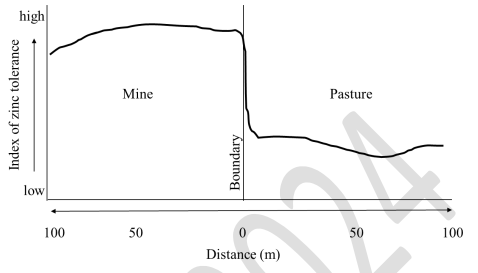
Which one or more of the following processes explain(s) the observed pattern of zinc tolerance in this grass species?From an original population \(P\) of a butterfly species, two experimental populations \(X\) and \(Y\) were established. In \(X\), males and females were maintained in standard conditions, and females were allowed to mate and lay eggs. Only eggs from females laying small clutches (i.e., \(S\) eggs or fewer) were allowed to hatch and the rest were not utilized. In \(Y\), males and females were maintained in standard conditions and females were allowed to mate and lay eggs. From each female, \(S\) eggs were randomly selected and allowed to hatch, and the rest were not utilized. After 20 generations of these experimental conditions, relative to the original population \(P\), and assuming that clutch size is under genetic control, we expect clutch size to be ______________________in \(X\) and ___________________ in \(Y\).


