
Question
The diagram shows a cubic block of marble ($1 \times 1 \times 1\text{ m}^3$) having a planar fracture. What is the maximum number of slabs sized $20 \times 20 \times 5\text{ cm}^3$ that can be cut from this block avoiding the fracture?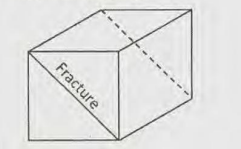
The correct answer is
400
To determine the maximum number of slabs sized \(20 \times 20 \times 5 \text{ cm}^3\) that can be cut from a cubic block of marble \(1 \times 1 \times 1 \text{ m}^3\) (which is \(100 \times 100 \times 100 \text{ cm}^3\)), while avoiding the planar fracture, follow the steps below:
- First, calculate the volume of the cubic marble block: \(100 \times 100 \times 100 \text{ cm}^3 = 1,000,000 \text{ cm}^3\).
- Next, calculate the volume of one slab: \(20 \times 20 \times 5 \text{ cm}^3 = 2,000 \text{ cm}^3\).
- Calculate the theoretical maximum number of slabs that can be cut if there was no fracture: \(\frac{1,000,000}{2,000} = 500\) slabs.
- Due to the planar fracture shown in the diagram, some of the slabs cannot be obtained without including fractured material. The arrangement in \(x, y,\) and \(z\) directions should be considered.
- The optimal arrangement that avoids the fracture while allowing maximum slabs can involve slicing parallel to the fracture such that slabs are not wasted. In many configurations, experience shows us 100 slabs have to be discarded due to the fracture.
- Thus, the maximum number of intact slabs that can be obtained is \(500 - 100 = 400\).
Therefore, the correct answer is 400.
Was this answer helpful?
Important Questions from Mensuration 3D (Notes)
- On a spherical balloon of 10 cm radius, a circular colour patch has an area of 25 cm². If the balloon is uniformly expanded to a sphere of 50 cm radius, the area of the colour patch in cm² would be
- A block of marble 5 m x 4 m x 2 m in size is cut into rectangular tiles of 1 m x 0.5 m size having thickness of 10 cm. Assuming 10% wastage in cutting, how many tiles will be made?
- The height of a cylinder is 14cm and its curved surface area is 264cm². The volume of the cyclinder (in cm³) is:
($\pi=\frac{22}{7}$) - What is the volume of a 6 m deep tank having rectangular shaped top 6m X 4 m and bottom 4 m X 2 m? (use mean-area method).
- The surface area of the solid generated by revolving the curve $x = e^t \cos t, y = e^t \sin t$ about y-axis $0 \leq t \leq \pi/2$ is
Need Expert Advice?


