
The conventional sign shown in the figure below represents a.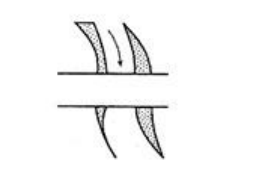
The question provides a conventional sign used in surveying and map reading to represent a certain type of bridge. It is crucial to identify the correct type from the options given: road bridge, railway bridge, canal bridge, and aqueduct.
Upon analyzing the image:
The symbol features parallel lines with an arrow pointing down, which is a common convention for representing a road bridge in topographic maps and surveying. This conclusion is derived from standard mapping symbols where different types of bridges have distinct identifiers:
- Road Bridge: Typically represented with simple lines and an arrow indicating the flow direction of the road.
- Railway Bridge: Often depicted with additional elements like crossbars or sleepers.
- Canal Bridge and Aqueduct: Usually have more complex details to indicate their structural differences and functionality. They are primarily related to water conveyance and have symbols indicating water flow.
Given the image and the options, the diagram best matches the description of a road bridge due to its simplicity and the illustrated arrow for vehicular flow. Therefore, the correct answer is:
Hence, option: road bridge is justified as it aligns with the conventional symbols used in surveying for a bridge intended for road traffic.
Important Questions from Linear Measurement
Which one is the CORRECT statement?
1 chain is equal to
The distance between two points measured using 20 m chain was recorded as 327 m. It was found that the chain is 3 cm too long. The true length of the line is
In a diagonal scale only
The principle of “working from whole to part” is used in surveying because


