The Boolean function Y = AB + CD is to be realized using only 2 input NAND gates. The minimum number of gates required is
3
To realize the Boolean function Y = AB + CD using only 2-input NAND gates, we need to convert the expression into a form that exclusively uses NAND operations. NAND gates are considered universal gates, meaning any Boolean function can be implemented using only NAND gates.
Boolean Function Transformation
The given Boolean function is in Sum of Products (SOP) form: Y = AB + CD.
Our goal is to transform this expression using De Morgan's theorems and double negation to obtain an equivalent expression that can be directly implemented with NAND gates.
Applying Double Inversion
First, we apply double inversion to the entire expression. Double inversion ($\overline{\overline{X}} = X$) does not change the logical value of the expression but allows us to manipulate it further using De Morgan's Theorem.
So, Y = AB + CD becomes $Y = \overline{\overline{AB + CD}}$
Applying De Morgan's Theorem
Next, we apply De Morgan's Theorem to the inner bar ($\overline{AB + CD}$). De Morgan's first theorem states that $\overline{A + B} = \overline{A} \cdot \overline{B}$.
Let $X_1 = AB$ and $X_2 = CD$. Then $\overline{AB + CD}$ becomes $\overline{X_1 + X_2} = \overline{X_1} \cdot \overline{X_2}$.
Substituting back, we get: $\overline{\overline{AB + CD}} = \overline{(\overline{AB}) \cdot (\overline{CD})}$
So, the function can be rewritten as: $Y = \overline{(\overline{AB}) \cdot (\overline{CD})}$
NAND Gate Implementation Steps
Now, let's analyze the rewritten expression $Y = \overline{(\overline{AB}) \cdot (\overline{CD})}$ to determine the minimum number of 2-input NAND gates required.
We can break down the realization into three distinct steps, each corresponding to a 2-input NAND gate:
- First NAND Gate (Gate 1): This gate takes inputs A and B.
- Output: $O_1 = \overline{AB}$
- Second NAND Gate (Gate 2): This gate takes inputs C and D.
- Output: $O_2 = \overline{CD}$
- Third NAND Gate (Gate 3): This gate takes the outputs of the first two NAND gates ($O_1$ and $O_2$) as its inputs.
- Inputs: $O_1$ and $O_2$
- Output: $Y = \overline{O_1 \cdot O_2} = \overline{(\overline{AB}) \cdot (\overline{CD})}$
According to De Morgan's Theorem, $\overline{(\overline{AB}) \cdot (\overline{CD})} = \overline{\overline{AB}} + \overline{\overline{CD}} = AB + CD$, which is our original function.
Minimum Gates Required
By following these steps, we can see that we have used exactly three 2-input NAND gates to realize the Boolean function Y = AB + CD.
Gate 1 produces $\overline{AB}$.
Gate 2 produces $\overline{CD}$.
Gate 3 combines $\overline{AB}$ and $\overline{CD}$ to produce $\overline{(\overline{AB}) \cdot (\overline{CD})}$, which simplifies to AB + CD.
Therefore, the minimum number of 2-input NAND gates required is 3.
Summary of Logic Gates
NAND gates are fundamental in digital electronics because of their universality. This means that any other basic logic gate (AND, OR, NOT, XOR, XNOR) can be constructed using only NAND gates. This property is highly valuable in integrated circuit design, as manufacturing a single type of gate simplifies the production process.
Important Questions from Realization of Logic Gates
Which of the following gates has output LOW if and only if all the inputs are HIGH?
The Boolean function Y = AB +CD is to be realized using only 2-input NAND gates.
The minimum number of gates required is
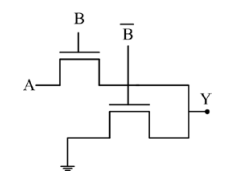
The logic functionality realized by the circuit shown below is ____________