The barrier voltage for germanium is _________ at 25°C.
Understanding Barrier Voltage in Germanium
The barrier voltage, also known as the potential barrier, is a crucial concept in semiconductor physics, particularly when dealing with p-n junctions like those found in diodes.
When a p-type semiconductor is joined with an n-type semiconductor, electrons from the n-side diffuse into the p-side, and holes from the p-side diffuse into the n-side. This diffusion creates a region near the junction depleted of mobile charge carriers (the depletion region). The exposed fixed ions (negative on the p-side, positive on the n-side) in this depletion region create an electric field. This electric field opposes further diffusion of charge carriers, establishing a potential difference across the junction. This potential difference is called the barrier voltage or potential barrier.
The magnitude of this barrier voltage depends on several factors, including:
- The type of semiconductor material used (e.g., Silicon or Germanium).
- The doping concentration of the semiconductor materials.
- The temperature.
Different semiconductor materials have different bandgap energies, which affects the barrier voltage. Germanium (Ge) has a smaller bandgap than Silicon (Si).
At a typical room temperature of 25°C, the approximate barrier voltage for common semiconductor materials is:
- Germanium (Ge): Approximately 0.3 V
- Silicon (Si): Approximately 0.7 V
The question asks specifically for the barrier voltage for germanium at 25°C. Based on the typical values, the barrier voltage for germanium at this temperature is around 0.3 V.
Important Questions from Characteristics of Power Diodes
When a diode is switching from conducting state to blocking state, it has stored charge which needs to be discharged before, it blocks reverse current, this time required is known as _______.
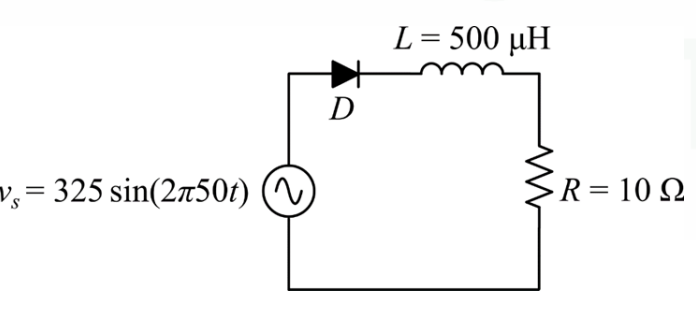
Consider the circuit shown. Assume that the diode $D$ is ideal. The supply voltage $v_s = 325 \sin(2\pi 50t) \text{ V}$, $L = 500 \mu H$, and $R = 10 \text{ }\Omega$. The peak diode current (in amperes) is ______________
(Round off to one decimal place)