
The bar carrying positive bending moment is bent up to resist negative bending moment is shown in which of the following figures?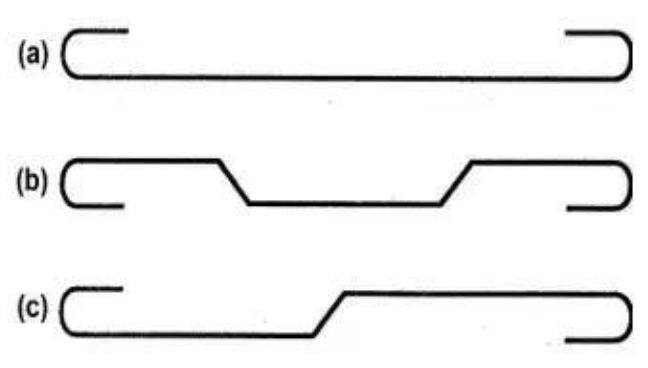
In designing reinforced concrete structures, a bent-up bar is used to resist negative bending moments. A positive bending moment typically occurs in the central span of a beam, while a negative bending moment is developed over the supports.
To effectively resist these moments, bars are bent up at points where negative moments are expected, usually close to the supports. This allows the reinforcement to actively engage in resisting the anticipated forces.
Let's analyze the given options:
- Option (a): This diagram shows a straight bar without any bends. Therefore, it is not suited for resisting negative bending moments.
- Option (b): This diagram shows a bar that is bent upwards in two places. However, the bends are located symmetrically in the center, which is unusual for typical support conditions and is more consistent with a different loading pattern.
- Option (c): **Correct Answer**. This diagram shows a bar bent upwards towards both ends, which is characteristic of how negative bending moments are resisted over supports in continuous spans or certain types of cantilever structures.
Option (c) is the correct answer as it illustrates a bar designed to counteract negative bending moments effectively. The bends help develop the required tension forces where bending is detrimental and need to be resisted actively.
Important Questions from Beams and Slabs
What should be the clear distance between the lateral restraint for continuous beams?
On what does the thickness of slab primarily depend?
For limit state design of RC beam consider following:
i) \(\left[ {\frac{{{f_y}}}{{{f_{ck}}}} = 0.36} \right]\)
ii) \(\left[ {\frac{{{A_{st}}}}{{bd}} = 4\% } \right]\)
iii) \(\left[ {\frac{{{x_{u\;max}}}}{d} = 0.48} \right]\)
Which one of the design criteria shall be applicable?In a doubly reinforced rectangular beam, bending stress induced in compression (i.e. concrete) and tension (i.e. steel) are σ ch and σ st , respectively. The depth of neutral axis is kd (where d is effective depth) from top compression face and modular ratio is m. Which one of the following represents correct combination in under reinforced beam?
In a RC cantilever beam which is subjected to downward load, tension reinforcement needs be provided at:


