
Finding the Area Between Parabola $x = -y^2$ and Line $y = x + 2$
To find the area bounded by the parabola $x = -y^2$ and the line $y = x + 2$, we first need to determine the points of intersection.
1. Find Intersection Points
Rewrite the line equation as $x = y - 2$. Set the expressions for $x$ equal to find the intersection points in terms of $y$:
$-y^2 = y - 2$
Rearrange the equation into a quadratic form:
$y^2 + y - 2 = 0$
Factor the quadratic equation:
$(y + 2)(y - 1) = 0$
This gives us the $y$-coordinates of the intersection points: $y = -2$ and $y = 1$.
2. Set Up the Integral for Area
The area can be calculated by integrating with respect to $y$. We need to identify the rightmost curve ($x_{right}$) and the leftmost curve ($x_{left}$) between $y = -2$ and $y = 1$.
- The parabola is $x = -y^2$.
- The line is $x = y - 2$.
To determine which curve is on the right, test a value of $y$ between $-2$ and $1$, for example, $y = 0$:
- For the parabola: $x = -(0)^2 = 0$.
- For the line: $x = 0 - 2 = -2$.
Since $0 > -2$, the parabola ($x = -y^2$) is the rightmost curve ($x_{right}$) and the line ($x = y - 2$) is the leftmost curve ($x_{left}$) in the interval $[-2, 1]$.
The area $A$ is given by the integral:
$A = \int_{-2}^{1} (x_{right} - x_{left}) \, dy$
$A = \int_{-2}^{1} (-y^2 - (y - 2)) \, dy$
$A = \int_{-2}^{1} (-y^2 - y + 2) \, dy$
3. Evaluate the Integral
Integrate the expression with respect to $y$:
$A = \left[ -\frac{y^3}{3} - \frac{y^2}{2} + 2y \right]_{-2}^{1}$
Evaluate the antiderivative at the upper and lower limits:
$A = \left( -\frac{(1)^3}{3} - \frac{(1)^2}{2} + 2(1) \right) - \left( -\frac{(-2)^3}{3} - \frac{(-2)^2}{2} + 2(-2) \right)$
$A = \left( -\frac{1}{3} - \frac{1}{2} + 2 \right) - \left( -\frac{-8}{3} - \frac{4}{2} - 4 \right)$
$A = \left( \frac{-2 - 3 + 12}{6} \right) - \left( \frac{8}{3} - 2 - 4 \right)$
$A = \left( \frac{7}{6} \right) - \left( \frac{8}{3} - 6 \right)$
$A = \frac{7}{6} - \left( \frac{8 - 18}{3} \right)$
$A = \frac{7}{6} - \left( -\frac{10}{3} \right)$
$A = \frac{7}{6} + \frac{10}{3}$
$A = \frac{7}{6} + \frac{20}{6}$
$A = \frac{27}{6}$
Simplify the result:
$A = \frac{9}{2}$
The area of the bounded region is $ \frac{9}{2} $.
Important Questions from Area Under Curve
- A function $y(x)$ is defined in the interval $[0, 1]$ on the x-axis as
$y(x) = \begin{cases} 2 & \text{if } 0 \le x < \frac{1}{3} \\ 3 & \text{if } \frac{1}{3} \le x < \frac{3}{4} \\ 1 & \text{if } \frac{3}{4} \le x \le 1 \end{cases}$
Which one of the following is the area under the curve for the interval $[0, 1]$ on the x-axis? The work done by the force $F = (x + y)\hat{i} - (x^2 + y^2)\hat{j}$, where $\hat{i}$ and $\hat{j}$ are unit vectors in $\vec{OX}$ and $\vec{OY}$ directions, respectively, along the upper half of the circle $x^2 + y^2 = 1$ from $(1,0)$ to $(-1,0)$ in the $xy$-plane is
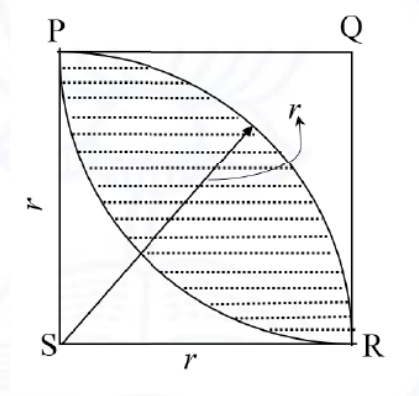
In the figure shown above, PQRS is a square. The shaded portion is formed by the intersection of sectors of circles with radius equal to the side of the square and centers at S and Q.
The probability that any point picked randomly within the square falls in the shaded area is ___________.- If $f(x) = 2 \ln(\sqrt{e^x})$, what is the area bounded by $f(x)$ for the interval $[0, 2]$on the x-axis?
- Define $[x]$ as the greatest integer less than or equal to $x$, for each $x \in (-\infty,\infty)$. If $y = [x]$, then area under $y$ for $x \in [1,4]$ is


