
Suppose three meetings of a group of professors were arranged in Mumbai, Delhi, and Chennai. Each professor of the group attended exactly two meetings. 21 professors attended the Mumbai meeting, 27 attended the Delhi meeting and 30 attended the Chennai meeting. How many of them attended both the Chennai and Delhi meetings?
18
Professors Attending Meetings
The question describes a scenario where a group of professors attended meetings in three cities: Mumbai, Delhi, and Chennai. Each professor attended exactly two out of the three meetings. We are given the total number of professors who attended each city's meeting and need to find the number of professors who attended both the Chennai and Delhi meetings.
Let's denote the set of professors who attended the Mumbai meeting as \(M\), the Delhi meeting as \(D\), and the Chennai meeting as \(C\). We are given the following information:
- Number of professors who attended the Mumbai meeting, \(|M| = 21\)
- Number of professors who attended the Delhi meeting, \(|D| = 27\)
- Number of professors who attended the Chennai meeting, \(|C| = 30\)
A key piece of information is that each professor attended exactly two meetings. This means there is no professor who attended only one meeting or all three meetings. The total group of professors can be divided into three distinct groups based on which pair of meetings they attended:
- Professors who attended Mumbai and Delhi, but not Chennai ($M \cap D \cap C'$). Let's call this group size \(x\).
- Professors who attended Mumbai and Chennai, but not Delhi ($M \cap C \cap D'$). Let's call this group size \(y\).
- Professors who attended Delhi and Chennai, but not Mumbai ($D \cap C \cap M'$). Let's call this group size \(z\).
Since each professor attended exactly two meetings, the total number of professors in the group is the sum of the sizes of these three groups: Total Professors = \(x + y + z\).
Also, the number of professors who attended a specific city's meeting is the sum of the sizes of the two groups that include that city. For example, the professors who attended the Mumbai meeting are those who attended Mumbai and Delhi (but not Chennai) plus those who attended Mumbai and Chennai (but not Delhi).
This gives us the following system of equations:
- Professors in Mumbai meeting: \(|M| = x + y = 21\)
- Professors in Delhi meeting: \(|D| = x + z = 27\)
- Professors in Chennai meeting: \(|C| = y + z = 30\)
We are asked to find the number of professors who attended both the Chennai and Delhi meetings. Since each professor attended exactly two meetings, this group consists precisely of those who attended Delhi and Chennai but not Mumbai. This is the group we denoted by \(z\).
We can solve this system of equations for \(x\), \(y\), and \(z\). One way is to add all three equations:
\((x + y) + (x + z) + (y + z) = 21 + 27 + 30\)
\(2x + 2y + 2z = 78\)
Divide by 2:
\(x + y + z = 39\)
We know that \(x + y = 21\) from equation (1). Substitute this into the equation \(x + y + z = 39\):
\(21 + z = 39\)
Now, solve for \(z\):
\(z = 39 - 21\)
\(z = 18\)
The value \(z\) represents the number of professors who attended both the Delhi and Chennai meetings (and no other meeting, as each attended exactly two). So, 18 professors attended both the Chennai and Delhi meetings.
Let's verify this by finding \(x\) and \(y\):
From \(x + z = 27\) and \(z = 18\), we get \(x + 18 = 27\), so \(x = 9\).
From \(y + z = 30\) and \(z = 18\), we get \(y + 18 = 30\), so \(y = 12\).
Check equation (1): \(x + y = 9 + 12 = 21\), which matches the given information for Mumbai attendance.
The sizes of the three groups are:
- Mumbai & Delhi (only): \(x = 9\)
- Mumbai & Chennai (only): \(y = 12\)
- Delhi & Chennai (only): \(z = 18\)
Total professors = \(x + y + z = 9 + 12 + 18 = 39\).
The number of professors who attended both the Chennai and Delhi meetings is \(z\), which is 18.
Detailed Breakdown of Meeting Attendance
| Group Description | Mathematical Notation | Number of Professors |
|---|---|---|
| Attended Mumbai & Delhi (only) | \(|M \cap D \cap C'| = x\) | 9 |
| Attended Mumbai & Chennai (only) | \(|M \cap C \cap D'| = y\) | 12 |
| Attended Delhi & Chennai (only) | \(|D \cap C \cap M'| = z\) | 18 |
| Total Professors | \(x+y+z\) | 39 |
The number of professors who attended both the Chennai and Delhi meetings is 18.
Important Questions from Venn Diagram Problems
In a group of 73 friends, 14 friends go to Gym and Karate classes both, whereas 7 friends neither go to Gym class nor to Karate class. If a total of 36 friends go to Gym class, then how many friends go to only Karate class?
In an examination 20% students failed in Mathematics and 15% failed in English. If 10% failed in both and those who passed in both numbered 300, then the total number of students who appeared in the examination was
In the following diagram, the 'circle' stands for 'soldiers', the 'square' stands for 'Indians', and the 'triangle' stands for 'singers'. The numbers given in the different segments represent persons belonging to that category.
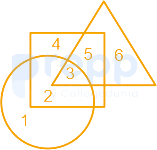
Which category is represented by the number '5'?
- In the following diagram, the circle stands for 'policemen', the square stands for 'sportspersons' and the 'triangle' stands for 'tax-payers' the numbers given in the different segments represent the number of persons in that category.
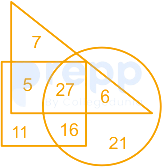
How many policemen are tax-payers but are NOT sportspersons?
Which of the following Venn diagrams represents the relationship between Lions, Deers and Carnivores?


