
SO2 Diffusion Flux Calculation
This section outlines the calculation of the steady-state molar flux ($J_A$) for sulfur dioxide ($SO_2$) gas diffusing through a stagnant air-film, applying Fick's First Law of Diffusion.
Given Parameters
- Film Thickness, $\Delta x = 2$ mm $= 2 \times 10^{-3}$ m
- Diffusion Coefficient, $D_{AB} = 1 \times 10^{-5}$ m$^2$ s$^{-1}$
- Partial Pressure of $SO_2$ at side 1, $P_{A1} = 0.15$ bar
- Partial Pressure of $SO_2$ at side 2, $P_{A2} = 0.05$ bar
- Temperature, $T = 30^\circ$C $= 303.15$ K
- Universal Gas Constant, $R = 8.314$ J mol$^{-1}$ K$^{-1}$
Diffusion Flux Formula
For steady-state diffusion of component A through stagnant component B under ideal gas conditions, the molar flux ($J_A$) can be calculated using the relation derived from Fick's Law:
$J_A = \frac{D_{AB}}{R T} \frac{P_{A1} - P_{A2}}{\Delta x}$
Unit Conversions and Calculation Setup
Convert the pressure difference to Pascals (Pa) and ensure all other values are in SI units:
- Pressure Difference: $\Delta P_A = P_{A1} - P_{A2} = (0.15 - 0.05)$ bar $= 0.10$ bar $= 0.10 \times 10^5$ Pa $= 10^4$ Pa
Flux Calculation
Substitute the values in SI units into the diffusion flux formula:
$J_A = \frac{(1 \times 10^{-5} \text{ m}^2 \text{ s}^{-1}) \times (1 \times 10^4 \text{ Pa})}{(8.314 \text{ J mol}^{-1} \text{ K}^{-1}) \times (303.15 \text{ K}) \times (2 \times 10^{-3} \text{ m})}$
Calculate the denominator:
$(8.314 \text{ J mol}^{-1} \text{ K}^{-1}) \times (303.15 \text{ K}) \times (2 \times 10^{-3} \text{ m}) = 5.04308 \text{ J mol}^{-1} \text{ m}$
Calculate the numerator:
$(1 \times 10^{-5} \text{ m}^2 \text{ s}^{-1}) \times (1 \times 10^4 \text{ Pa}) = 0.1 \text{ m}^2 \text{ s}^{-1} \text{ Pa}$
Now, compute the flux:
$J_A = \frac{0.1 \text{ m}^2 \text{ s}^{-1} \text{ Pa}}{5.04308 \text{ J mol}^{-1} \text{ m}} \approx 0.0198 \text{ mol m}^{-2} \text{ s}^{-1}$
Result
The calculated steady-state flux of $SO_2$ is approximately $0.0198$ mol m$^{-2}$ s$^{-1}$. This value corresponds most closely to Option B.
Important Questions from Molecular Diffusion
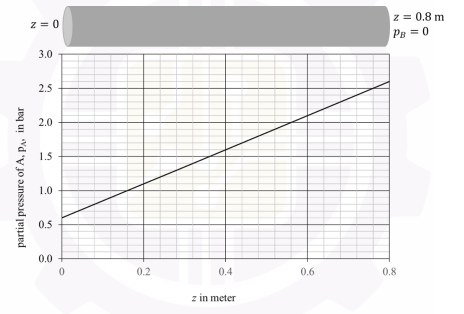
Consider a non-reactive binary mixture of two ideal gases A and B in an isothermal horizontal closed tube. Due to the concentration difference at the two ends of the tube, equimolal counterdiffusion occurs along the axial direction. No concentration gradients exist in the radial direction. The profile for partial pressure of component A ($p_A$) as a function of axial distance $z$ is shown in the figure. The partial pressure of component B ($p_B$) approaches zero at $z = 0.8 \text{ m}$. At a location $z = z_1$ the partial pressures of the components A and B are equal. The value of $z_1$ (in m) is _____ (rounded off to two decimal places).
- For a binary mixture of components A and B, $N_A$ and $N_B$ denote the total molar fluxes of components A and B, respectively. $J_A$ and $J_B$ are the corresponding molar diffusive fluxes. Which of the following is true for equimolar counter-diffusion in the binary mixture?
- Consider the following two cases for a binary mixture of ideal gases A and B under steady state conditions. In Case 1, the diffusion of A occurs through non-diffusing B. In Case 2, equimolal counter diffusion of A and B occurs. In both the cases, the total pressure is 100 kPa and the partial pressures of A at two points separated by a distance of 10 mm are 10 kPa and 5 kPa. Assume that the Fick's first law of diffusion is applicable. What is the ratio of molar flux of A in Case 1 to that in Case 2?
- In a binary gas-liquid system, $N_{A,EMD}$ is the molar flux of a gas $A$ for equimolar counter diffusion with a liquid $B$. $N_{A,UMD}$ is the molar flux of $A$ for steady one- component diffusion through stagnant $B$. Using the mole fraction of $A$ in the bulk of the gas phase as $0.2$ and that at the gas-liquid interface as $0.1$ for both the modes of diffusion, the ratio of $N_{A,UMD}$ to $N_{A,EMD}$ is equal to ________ (rounded off to two decimal places).
- Consider two stationary spherical pure water droplets of diameters $d_1$ and $2d_1$. $CO_2$ diffuses into the droplets from the surroundings. If the rate of diffusion of $CO_2$ into the smaller droplet is $W_1$ mol $s^{-1}$, the rate of diffusion of $CO_2$ into the larger droplet is


