
Understanding the Problem
The question asks for the ratio of the molar flux of species A in two different diffusion scenarios within a binary mixture of ideal gases (A and B). We are given conditions for Case 1 (diffusion of A through stagnant B) and Case 2 (equimolal counter diffusion of A and B). Fick's first law is applicable.
Key Information
- Total Pressure: $P_{total} = 100$ kPa
- Distance: $\Delta z = 10$ mm = $0.01$ m
- Partial Pressure of A at point 1: $P_{A1} = 10$ kPa
- Partial Pressure of A at point 2: $P_{A2} = 5$ kPa
Formulating the Molar Flux Equations
We need the expressions for the molar flux of A ($N_{A1}$ in Case 1 and $N_{A2}$ in Case 2) relative to a stationary coordinate system.
Case 1: Diffusion of A through Non-Diffusing B
In this scenario, component B is stagnant ($v_B = 0$). The molar flux of A relative to the stagnant medium is described by:
$N_{A1} = \frac{P_{total} D_{AB}}{P_{B,avg} RT \Delta z} (P_{A1} - P_{A2})$
where $P_{B,avg}$ is the average partial pressure of B across the diffusion path.
Case 2: Equimolal Counter Diffusion
Here, the molar fluxes of A and B are equal in magnitude and opposite in direction ($N_A = -N_B$), meaning the total molar flux is zero ($N_{total} = 0$). The molar flux of A is given by:
$N_{A2} = -C_{total} D_{AB} \frac{dx_A}{dz}$
For ideal gases, $C_{total} = P_{total}/(RT)$ and $x_A = P_A/P_{total}$. Assuming a linear partial pressure profile:
$N_{A2} = \frac{D_{AB}}{RT \Delta z} (P_{A1} - P_{A2})$
Calculating the Ratio of Molar Fluxes
The required ratio is $\frac{N_{A1}}{N_{A2}}$.
Ratio $= \frac{\frac{P_{total} D_{AB}}{P_{B,avg} RT \Delta z} (P_{A1} - P_{A2})}{\frac{D_{AB}}{RT \Delta z} (P_{A1} - P_{A2})}$
The terms $D_{AB}$, $RT$, $\Delta z$, and $(P_{A1} - P_{A2})$ cancel out, leaving:
Ratio $= \frac{P_{total}}{P_{B,avg}}$
Determining $P_{B,avg}$
First, find the average partial pressure of A ($P_{A,avg}$):
$P_{A,avg} = \frac{P_{A1} + P_{A2}}{2} = \frac{10 \text{ kPa} + 5 \text{ kPa}}{2} = 7.5 \text{ kPa}$
Next, find the average partial pressure of B ($P_{B,avg}$):
$P_{B,avg} = P_{total} - P_{A,avg} = 100 \text{ kPa} - 7.5 \text{ kPa} = 92.5 \text{ kPa}$
Final Calculation
Now, calculate the ratio:
Ratio $= \frac{100 \text{ kPa}}{92.5 \text{ kPa}} \approx 1.08108$
Rounding to two decimal places, the ratio is 1.08.
Important Questions from Molecular Diffusion
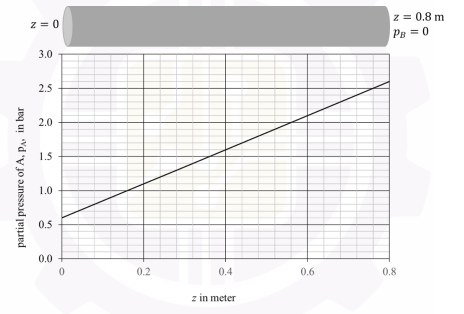
Consider a non-reactive binary mixture of two ideal gases A and B in an isothermal horizontal closed tube. Due to the concentration difference at the two ends of the tube, equimolal counterdiffusion occurs along the axial direction. No concentration gradients exist in the radial direction. The profile for partial pressure of component A ($p_A$) as a function of axial distance $z$ is shown in the figure. The partial pressure of component B ($p_B$) approaches zero at $z = 0.8 \text{ m}$. At a location $z = z_1$ the partial pressures of the components A and B are equal. The value of $z_1$ (in m) is _____ (rounded off to two decimal places).
- For a binary mixture of components A and B, $N_A$ and $N_B$ denote the total molar fluxes of components A and B, respectively. $J_A$ and $J_B$ are the corresponding molar diffusive fluxes. Which of the following is true for equimolar counter-diffusion in the binary mixture?
- In a binary gas-liquid system, $N_{A,EMD}$ is the molar flux of a gas $A$ for equimolar counter diffusion with a liquid $B$. $N_{A,UMD}$ is the molar flux of $A$ for steady one- component diffusion through stagnant $B$. Using the mole fraction of $A$ in the bulk of the gas phase as $0.2$ and that at the gas-liquid interface as $0.1$ for both the modes of diffusion, the ratio of $N_{A,UMD}$ to $N_{A,EMD}$ is equal to ________ (rounded off to two decimal places).
- Consider two stationary spherical pure water droplets of diameters $d_1$ and $2d_1$. $CO_2$ diffuses into the droplets from the surroundings. If the rate of diffusion of $CO_2$ into the smaller droplet is $W_1$ mol $s^{-1}$, the rate of diffusion of $CO_2$ into the larger droplet is
- Consider steady-state diffusion in a binary A-B liquid at constant temperature and pressure. The mole-fraction of A at two different locations is $0.8$ and $0.1$. Let $N_{A1}$ be the diffusive flux of A calculated assuming B to be non-diffusing, and $N_{A2}$ be the diffusive flux of A calculated assuming equimolar counter-diffusion. The quantity $\frac{(N_{A1}-N_{A2})}{N_{A1}} \times 100$ is ________ (rounded off to one decimal place).


