
Statement (I): While you are travelling in a bus when a sudden brake is applied the upper part of your body leans in the forward direction. Statement (II): The non-resistance of a body to change its state of motion is called inertia of motion.
Statement (I) is correct but Statement (II) is incorrect.
When a moving bus suddenly brakes, the lower part of the body stops with the bus while the upper part continues moving forward due to inertia, so Statement I is correct. However, inertia of motion is actually the tendency of a body to resist any change in its state of motion, not a "non-resistance" to change as Statement II wrongly states, so Statement II is incorrect.
Important Questions from Laws of Motion
Which one of the following is an example of Second Class Lever?
A uniform meter scale of mass 0.24 kg is made of steel. It is kept on two wedges, W1 and W2 , in a horizontal position. W1 is at a distance of 0.2 m from one of its ends, while W2 is at distance of 0.4 m from the other end. If the force on the scale is N1 due to W1 and N2 due to W2, then : (take g =10·0 m s-2
Consider a journey by a car represented by the graph given below in three parts A, B and C. The speed of the car in these parts is Va, Vb and Vc, respectively:
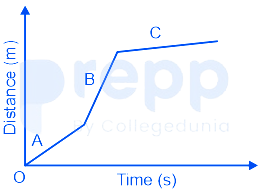
Which one of the following is correct in this case?
Rocket works on the principle of:
A rocket is launched to travel vertically upward with a constant velocity of 20 m/s. After travelling for 35 seconds, the rocket develops a snag and its fuel supply is cut off. The rocket then travels like a free body. The height achieved by it is:


