
$ \sqrt[3]{0.99}$ is closest to
Approximating the Cube Root of 0.99
The question asks us to find the value closest to the cube root of 0.99, denoted as $ \sqrt[3]{0.99} $. We need to compare this value to the given options: 0.33, 0.14, 0.99, and 0.45.
Intuitive Estimation
We know that the cube root of 1 is 1 ($ \sqrt[3]{1} = 1 $). Since 0.99 is very close to 1, its cube root should also be very close to 1. Let's examine the options:
- 0.33 is much smaller than 1.
- 0.14 is much smaller than 1.
- 0.99 is very close to 1.
- 0.45 is much smaller than 1.
Based on this simple estimation, 0.99 appears to be the most likely answer.
Using Calculus for Approximation
We can use linear approximation to get a more precise estimate. Let the function be $ f(x) = \sqrt[3]{x} = x^{1/3} $. We want to approximate $ f(0.99) $. We can use the point $ a=1 $ where the function value and its derivative are easy to calculate.
The linear approximation formula is:
$ f(x) \approx f(a) + f'(a)(x-a) $
- Calculate the function value at a:
$ f(1) = \sqrt[3]{1} = 1 $
- Find the derivative of the function:
$ f'(x) = \frac{d}{dx}(x^{1/3}) = \frac{1}{3}x^{(1/3 - 1)} = \frac{1}{3}x^{-2/3} $
- Calculate the derivative value at a:
$ f'(1) = \frac{1}{3}(1)^{-2/3} = \frac{1}{3}(1) = \frac{1}{3} $
- Apply the linear approximation formula with $ x = 0.99 $ and $ a = 1 $:
$ f(0.99) \approx f(1) + f'(1)(0.99 - 1) $
$ f(0.99) \approx 1 + \frac{1}{3}(0.99 - 1) $
$ f(0.99) \approx 1 + \frac{1}{3}(-0.01) $
$ f(0.99) \approx 1 - \frac{0.01}{3} $
$ f(0.99) \approx 1 - 0.00333... $
$ f(0.99) \approx 0.99667 $
Comparing the Approximation with Options
Our calculated approximation is $ \approx 0.99667 $. Let's see which option is closest to this value:
| Option | Value | Difference from 0.99667 |
|---|---|---|
| 1 | 0.33 | $ |0.99667 - 0.33| = 0.66667 $ |
| 2 | 0.14 | $ |0.99667 - 0.14| = 0.85667 $ |
| 3 | 0.99 | $ |0.99667 - 0.99| = 0.00667 $ |
| 4 | 0.45 | $ |0.99667 - 0.45| = 0.54667 $ |
The smallest difference is 0.00667, which corresponds to option 3 (0.99).
Conclusion
Both the intuitive approach and the linear approximation method show that 0.99 is the value closest to $ \sqrt[3]{0.99} $ among the given choices.
Important Questions from Simplification (Notes)
- In the Delhi zoo, there are some ducks and rabbits. If the heads are counted there are 160, while the legs are 450. What will be number of ducks in the zoo ?
Identify the number that will replace the question mark in the second equation based on the relationship represented in the first equation.
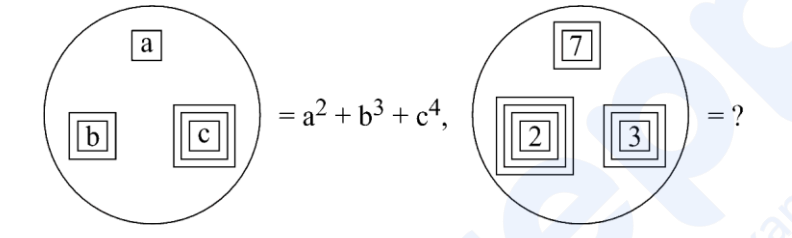
What value should come in the place of question mark (?) in the following equation?
$(0.008\div?) + (0.006 \div 0.03) + (0.008 \div 0.04) =0.5$If 'I' stands for '+', 'J' stands for 'x', 'K' stands for '÷', and 'L' stands for '-', then what will come in place of the question mark (?) in the following equation?
6 K 2 J 4 L 3 I 9 = ?If 'A' stands for '$\div $', 'B' stands for 'x', 'C' stands for '+' and 'D' stands for '-', then what will come in place of the question mark (?) in the following equation?
33 A 3 C 4 B 2 D 4 A 2 = ?


