
Some equipotential surfaces are shown. What is the magnitude and direction of electric field?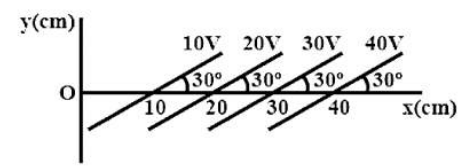
200 V/m making an angle of 120° with x-axis
Electric field (E) is given by the relation \( E = -\frac{\Delta V}{\Delta x} \). The voltage difference between successive surfaces is 10V, and the distance is 10 cm (0.1 m), so \( E = \frac{10}{0.1} = 100 V/m \). The direction is perpendicular to equipotential lines, leading to an effective angle of 120° with the x-axis.
Important Questions from Electrostatic Potential and Capacitance
A copper ball of density 8.0 g/cc and 1 cm in diameter is immersed in oil of density 0.8 g/cc. The charge on the ball if it remains just suspended in oil in an electric field of intensity 600π V/m acting in the upward direction is:
A metal wire is subjected to a constant potential difference. When the temperature of the metal wire increases, the drift velocity of the electrons in it:
A cube of side 'a' has a charge Q at each of its vertices. What is the potential due to this charge array at the centre of the cube?
A parallel plate capacitor with air between the plates has a capacitance of 6pF. What will be the capacitance if the distance between the plates is reduced to half and the space is filled with a dielectric constant 5?
What is the unit of electric flux in terms of the base units of SI?


