
Shown in the figure are two hollow cubes \(C_1\) and \(C_2\) of negligible mass partially filled (depicted by darkened area) with liquids of densities \(p_1\) and \(p_2\), respectively, floating in water (density \(p_w\)). The relationship between \(p_1\), \(p_2\) and \(p_w\) is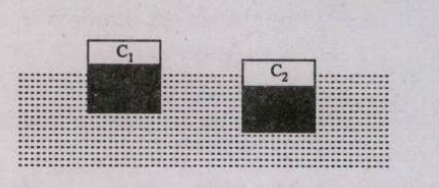
To solve the problem, we need to analyze the buoyancy and floating conditions of the cubes shown in the image. Understanding how these cubes float will help us determine the relationship between the densities of the liquids inside them (\(p_1\) and \(p_2\)) and the density of water (\(p_w\)).
Let's discuss the concepts involved:
- Buoyant Force: According to Archimedes' principle, a body submerged or floating in a fluid experiences an upward buoyant force equal to the weight of the fluid displaced by the body.
- Equilibrium Condition: For the cubes to float, the weight of each cube must equal the buoyant force exerted by the water.
Observing the image:
From the image, we see:
- The cube \(C_1\) is floating with a larger portion submerged compared to cube \(C_2\).
- The larger the submerged portion, the greater the buoyant force needed, which implies the weight of the fluid inside \(C_1\) is less than that in \(C_2\).
Since both cubes have negligible mass, the densities will influence how much they are submerged:
- \(C_1\) requires more buoyancy (a larger submerged volume), indicating \(p_1\) is less than \(p_w\) (as it's less dense, it displaces less water weight).
- \(C_2\) is submerged less, indicating \(p_2\) is greater than \(p_w\) (as it's denser, it requires less displacement to balance out).
Based on this reasoning, the relationship is:
\(p_1 < p_w < p_2\)
Therefore, the correct answer is \(p_1 < p_w < p_2\).
Similar Questions
A pumpkin weighs 7.5 N. On sub merging it completely in water, \(\frac{1}{2}L\) of water gets displaced. The acceleration due to gravity at the place where the pumpkin was weighed is \(10 \ m/s^2\). Which one of the following is the correct value of the density of the pumpkin ?
Important Questions from Fluids
What is the largest average velocity of blood flow in an artery of radius 4 × 10⁻³ m if the flow must remain laminar? Also, determine the corresponding flow rate? (Consider viscosity of blood to be 2.084 × 10⁻³ pa s.)
Two substances of densities r 1and r 2are mixed in equal volume and their relative density is 4.
When they are mixed in equal masses, relative density is 3. The values of r 1and r 2respectively areIf some object is weighed when submerged in water, what will happen to its weight compared to its weight in air?
- A fluid in equilibrium can't sustain _________.
- Which of the following statement(s) is/are true about the pressure exerted by fluids?
(i) Fluids exert pressure on the base and walls of the container in which they are enclosed.
(ii) Pressure exerted in any confined mass of fluid is transmitted unequally in different directions.



