
A pumpkin weighs 7.5 N. On sub merging it completely in water, \(\frac{1}{2}L\) of water gets displaced. The acceleration due to gravity at the place where the pumpkin was weighed is \(10 \ m/s^2\). Which one of the following is the correct value of the density of the pumpkin ?
Pumpkin Density Calculation
This problem requires calculating the density of a pumpkin using its weight, the volume of water displaced upon complete submersion, and the local acceleration due to gravity. Density is a measure of mass per unit volume.
Pumpkin Weight and Gravity Provided
We are given the following information:
- Weight of the pumpkin, \(W = 7.5 \ N\). Weight is the force due to gravity acting on an object's mass.
- Acceleration due to gravity, \(g = 10 \ m/s^2\). This is the rate at which objects accelerate downwards due to gravity at this specific location.
- Volume of water displaced, \(V_{disp} = \frac{1}{2} L\). When an object is submerged, it pushes aside a volume of fluid equal to its own volume. We need to convert Liters (L) to cubic meters (\(m^3\)) for consistency in units. Recall that \(1 \ L = 0.001 \ m^3\). Therefore, the volume of displaced water is \(V_{disp} = 0.5 \ L = 0.5 \times 0.001 \ m^3 = 0.0005 \ m^3\).
Pumpkin Mass Calculation
The fundamental definition of density (\(\rho\)) is mass (m) divided by volume (V), expressed as \(\rho = \frac{m}{V}\). To calculate the density of the pumpkin, we first need to determine its mass. We know the pumpkin's weight (W) and the acceleration due to gravity (g). The relationship between these quantities is given by the formula \(W = m \times g\). We can rearrange this formula to solve for mass:
\(m = \frac{W}{g}\)
Substituting the given values into the formula:
\(m = \frac{7.5 \ N}{10 \ m/s^2} = 0.75 \ kg\)
Thus, the mass of the pumpkin is calculated to be 0.75 kg.
Pumpkin Volume Determination
Archimedes' principle states that the buoyant force on an object submerged in a fluid is equal to the weight of the fluid displaced by the object. Crucially for this problem, when an object is *completely submerged*, the volume of the fluid it displaces is exactly equal to the object's own volume. Since the pumpkin is completely submerged in water:
\(V_{pumpkin} = V_{disp}\)
Using the converted volume of displaced water:
\(V_{pumpkin} = 0.0005 \ m^3\)
Therefore, the volume of the pumpkin is 0.0005 \(m^3\).
Pumpkin Density Calculation
With the mass and volume of the pumpkin now determined, we can calculate its density using the density formula \(\rho = \frac{m}{V}\).
Plugging in our calculated values for mass and volume:
\(\rho_{pumpkin} = \frac{0.75 \ kg}{0.0005 \ m^3}\)
Performing the division gives us the density:
\(\rho_{pumpkin} = 1500 \ kg/m^3\)
Conclusion: Pumpkin Density Options
We have calculated the mass and volume of the pumpkin using the provided information, and then determined its density. The question asks us to select the correct value from the given options.
The options are:
- 1. \(10 \ kg/m^3\)
- 2. \(100 \ kg/m^3\)
- 3. \(1000 \ kg/m^3\)
- 4. \(10000 \ kg/m^3\)
The correct value of the density of the pumpkin is 1000 kg/m\(^3\).
Similar Questions
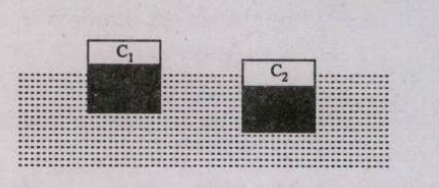
Shown in the figure are two hollow cubes \(C_1\) and \(C_2\) of negligible mass partially filled (depicted by darkened area) with liquids of densities \(p_1\) and \(p_2\), respectively, floating in water (density \(p_w\)). The relationship between \(p_1\), \(p_2\) and \(p_w\) is
Important Questions from Fluids
What is the largest average velocity of blood flow in an artery of radius 4 × 10⁻³ m if the flow must remain laminar? Also, determine the corresponding flow rate? (Consider viscosity of blood to be 2.084 × 10⁻³ pa s.)
Two substances of densities r 1and r 2are mixed in equal volume and their relative density is 4.
When they are mixed in equal masses, relative density is 3. The values of r 1and r 2respectively areIf some object is weighed when submerged in water, what will happen to its weight compared to its weight in air?
- A fluid in equilibrium can't sustain _________.
- Which of the following statement(s) is/are true about the pressure exerted by fluids?
(i) Fluids exert pressure on the base and walls of the container in which they are enclosed.
(ii) Pressure exerted in any confined mass of fluid is transmitted unequally in different directions.



