Statements:
Some petals are flowers.
No flower is a bat.
Conclusions:
(I) Some petals are bats.
(II) Some flowers are petals.
Analyzing Logical Reasoning: Petals, Flowers, and Bats
This problem requires us to analyze a set of statements and determine which of the given conclusions logically follow from them. We need to assume the statements are true, even if they seem unusual.
Understanding the Statements
Let's break down the given statements:
-
Statement 1: Some petals are flowers.
This means there is at least one petal that is also a flower. It implies an overlap between the group of 'petals' and the group of 'flowers'. We can represent this using set notation as $P \cap F \neq \emptyset$, where $P$ is the set of petals and $F$ is the set of flowers.
-
Statement 2: No flower is a bat.
This indicates that the group of 'flowers' and the group of 'bats' are entirely separate. There is no common member between them. In set notation, this is $F \cap B = \emptyset$, where $B$ is the set of bats.
Evaluating the Conclusions
Now, let's examine each conclusion based on these statements:
Evaluating Conclusion (I): Some petals are bats
Statement 1 tells us some petals belong to the flower category ($P \cap F \neq \emptyset$). Statement 2 tells us that anything in the flower category cannot be a bat ($F \cap B = \emptyset$).
From these two facts, we know that the specific petals which are also flowers cannot be bats. However, Statement 1 doesn't tell us anything about the petals that are *not* flowers. It's possible that some petals which are *not* flowers could be bats, but it's also possible they are not. The given statements do not provide enough information to guarantee that there is any overlap between the set of petals and the set of bats ($P \cap B \neq \emptyset$). Therefore, Conclusion (I) does not necessarily follow.
Evaluating Conclusion (II): Some flowers are petals
Statement 1 explicitly states, "Some petals are flowers." This implies a direct relationship where members exist in the intersection of the 'petals' set and the 'flowers' set.
If it's true that some petals are flowers, it logically and directly follows that some flowers must also be petals. The overlap identified in Statement 1 inherently means that the members in that overlap are counted in both categories. Thus, the existence of flowers that are petals is confirmed by Statement 1. In set notation, if $P \cap F \neq \emptyset$, then it must also be true that $F \cap P \neq \emptyset$. Therefore, Conclusion (II) logically follows.
Final Determination
Based on the analysis:
- Conclusion (I) does not logically follow from the statements.
- Conclusion (II) logically follows from the statements.
Therefore, only Conclusion (II) follows.
Important Questions from Syllogism (Notes)
- Disregard commonly known facts. Which conclusion would follow on the basis of given statements only.
Statement: Some bottles are car. some cars are cycle.
Conclusion:
(I) Some bottles are cycle is a possibility
(II) All bottles are cycle
In light of the above statements, choose the most appropriate answer from the options given below. - Read the given statements and conclusions carefully. Assuming that the information given in the statements is true, even if it appears to be at variance with commonly known facts, decide which of the given conclusions logically follow(s) from the statements.
Statements:
Some canals are rivers.
Some rivers are oceans.
Some oceans are ponds.
Conclusions:
(I) All ponds are rivers.
(II) All oceans are canals. - Read the given statements and conclusions carefully. Assuming that the information given in the statements is true, even if it appears to be at variance with commonly known facts, decide which of the given conclusions logically follow(s) from the statements.
Statements:
All bananas are apples.
All apples are grapes.
Some grapes are oranges.
Conclusions:
(I) All grapes are bananas.
(II) All oranges are apples. Take the given statements to be true even if they seem to be at variance with commonly known facts. Then decide which of the given conclusions logically follow the given statements.
Statements :
0% chairs are tables.
All computers are chairs.
Some books are tables.
Conclusions :
I. Not a single table is a computer.
II. Some books are not chairs.
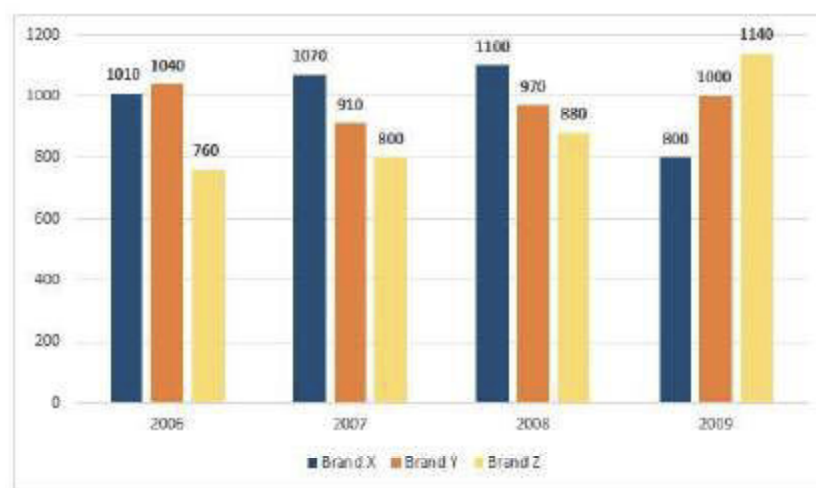
Directions: Study the following Bar-chart and the data provided to answer the questions that follow: Sales of 3-different companies selling T-Shirts for the years from 2006 to 2009 are given. How much percentage of sales decreased for Brand X T-shirt in 2009 compared with 2007?