
Read the following statements about land and sea breeze and choose the CORRECT answer. I. The land breeze is less extensive both vertically and horizontally than the sea breeze II. Temperature differences between land and sea are rarely as great at night as in the day time.
This question relates to the characteristics and causes of land and sea breezes, which are types of local winds driven by differential heating of land and sea.
Statement I Analysis: Land Breeze vs. Sea Breeze Extent
The statement asserts that the land breeze is less extensive, both vertically and horizontally, compared to the sea breeze. This is generally true.
- Sea Breeze (Daytime): During the day, land heats up faster than the sea. This creates a low-pressure area over the land and a high-pressure area over the cooler sea. Air flows from the sea to the land, forming the sea breeze. This process is driven by a significant temperature and pressure difference, making the sea breeze typically stronger and more extensive.
- Land Breeze (Nighttime): At night, land cools down faster than the sea. The sea becomes warmer relative to the land, creating a low-pressure area over the sea and a high-pressure area over the cooler land. Air flows from the land to the sea, forming the land breeze. This temperature and pressure difference is usually less pronounced than during the day, resulting in a weaker and less extensive land breeze.
Therefore, Statement I is correct.
Statement II Analysis: Temperature Differences
The statement claims that temperature differences between land and sea are rarely as great at night as during the day. This is also correct.
- Daytime Heating: Land absorbs solar radiation efficiently and heats up quickly. The sea has a higher heat capacity and mixing depth, so it heats up more slowly. This leads to a substantial temperature difference, with land being significantly warmer than the sea during the day, especially in the afternoon.
- Nighttime Cooling: Land loses heat rapidly via radiation after sunset, cooling down quickly. The sea, having absorbed and stored heat, cools down much more slowly. While a temperature difference persists, the *maximum* difference typically occurs during the day, and the difference may diminish or even reverse later in the night.
Thus, Statement II is correct.
Relationship Between Statements
Statement II provides the reason for Statement I.
- The larger temperature difference between land and sea during the day (explained by II) drives a stronger pressure gradient, resulting in a more powerful and extensive sea breeze (as stated in I).
- Conversely, the smaller temperature difference between land and sea at night leads to a weaker pressure gradient and a less extensive land breeze (also stated in I).
Therefore, both statements are correct, and Statement II correctly explains why Statement I is true.
Conclusion
Based on the analysis, both Statement I and Statement II are correct, and Statement II serves as the correct explanation for Statement I.
Important Questions from Physical Meteorology
- The maximum amount of water vapour which air can hold depends on
- Match the atmospheric optic phenomenon with the causative processes
A. Rainbows P. Refraction B. Mirage Q. Refraction and Reflection C. Corona R. Refraction, Reflection, Dispersion in ice crystals D. Halo S. Diffraction - The wavelength/colour at which solar radiation peaks is
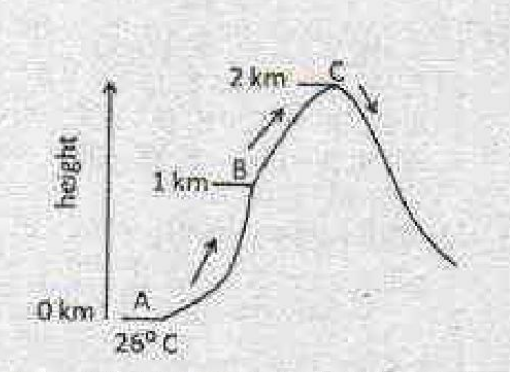
Air rises from point A to C. At point C it reaches the dew point and begins to descend on the leeward side because it is colder than its surroundings. What will happen to the temperature of the descending air?
- Which of the following is correct?


