
Air rises from point A to C. At point C it reaches the dew point and begins to descend on the leeward side because it is colder than its surroundings. What will happen to the temperature of the descending air?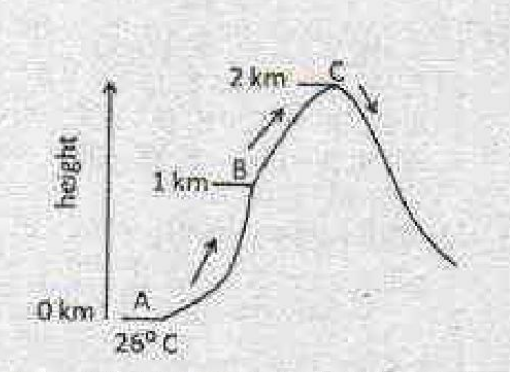
The given problem involves understanding the behavior of air masses as they rise and fall over a mountain, reaching a dew point and then descending. Let's break down the process step by step:
- The air at point A is at 25°C. As it rises to point C, it cools due to the adiabatic lapse rate. This can be the dry or moist adiabatic lapse rate, depending on whether the air is saturated.
- Upon reaching point C, the air reaches its dew point, meaning it has cooled sufficiently to reach saturation and condensation may occur.
- As the air descends on the leeward side, it begins to warm up. This is because descending air compresses under increasing atmospheric pressure, which increases its temperature adiabatically.
- Since the air is no longer saturating (as it is warming up and expanding), it will warm at the dry adiabatic lapse rate, which is typically about 10°C per kilometer.
Therefore, as the air descends from point C, its temperature will start to increase. This is a typical phenomenon observed in meteorology known as the "Foehn effect" or "Chinook winds."
Thus, the correct answer is: will start to increase
Important Questions from Physical Meteorology
- The maximum amount of water vapour which air can hold depends on
- Match the atmospheric optic phenomenon with the causative processes
A. Rainbows P. Refraction B. Mirage Q. Refraction and Reflection C. Corona R. Refraction, Reflection, Dispersion in ice crystals D. Halo S. Diffraction - The wavelength/colour at which solar radiation peaks is
Read the following statements about land and sea breeze and choose the CORRECT answer.
I. The land breeze is less extensive both vertically and horizontally than the sea breeze
II. Temperature differences between land and sea are rarely as great at night as in the day time.
- Which of the following is correct?


