
Read the following passage and answer the items that follow the passages. Your answers to these items should be based on the passage only. The flower was not invented to please us. It flaunted its petals and spread its perfume to attract an insect. The insect carries the pollen from flower to flower so that pollen is not carried away by wind and thus not wasted. What we call a flower's beauty is merely a by-product and a human invention. The perfume is not there to please us, it pleases us because it is there and we have been conditioned to it. Based on the above passage, the following assumptions have been made : 1. The author of the passage believes that flowers are creations of Nature's luxury. 2. The author of the passage does not believe in the usefulness of flowers except as things of Which of the assumptions given above is/are valid?
beauty.
Neither 1 nor 2
Assumption 1 is invalid: The passage does not suggest that flowers are creations of Nature's luxury. It emphasizes the functional role of flowers in attracting insects for pollination. The passage states, "The flower was not invented to please us. It flaunted its petals and spread its perfume to attract an insect." This indicates that flowers have a practical purpose rather than being luxurious creations.
Assumption 2 is invalid: The author believes flowers to have functional utility, rather than being things of beauty. S/he highlights the practical role of flowers in pollination: "The insect carries the pollen from flower to flower so that pollen is not carried away by wind and thus not wasted." This demonstrates the author's recognition of the usefulness of flowers beyond their beauty.
Important Questions from Miscellaneous Topics
- In communication the word 'Haptics' signifies :
- Which of the following statements best defines the scope of semiotics?
The compound interest on Rs. 75,000 for three years, at successive interest rates of 4%, 6% and 9% for each year respectively is:
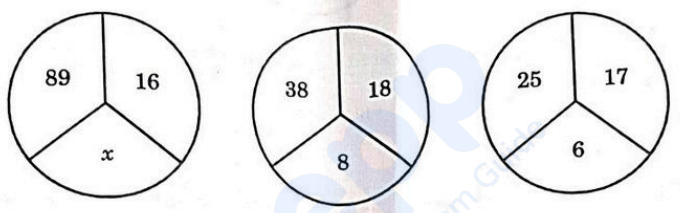
The value of x in the following figures is :
When a child reaches adolescence, there is apt to be a conflict between the parents and the child, since
the latter considers himself to be by now quite capable of managing his own affairs, while the former
are filled with parental solicitude, which is often a disguise for love of power. Parents consider, usually,
that the various moral problems which arise in adolescence are peculiarly their province. The options
they express, however, are so dogmatic that the young seldom confide in them, and usually go their
own way in secret.


