
Ratio of maximum shear stress to average shear stress is 4/3 in a ___________ section
circular
Shear Stress Ratio Explained
Shear stress is the stress component parallel to a material's cross-section. In structural members like beams, the shear stress distribution is not uniform across the cross-section. It varies depending on the shape of the section and the applied load. The question asks about the specific ratio between the maximum shear stress ($\tau_{max}$) and the average shear stress ($\tau_{avg}$) for a particular shape, which is given as a circular section.
Shear Stress Ratio Comparison
The distribution of shear stress and the resulting ratio of maximum to average shear stress differ for various cross-sectional shapes. Here’s a comparison for common shapes:
| Cross-Section Shape | Ratio ($\frac{\tau_{max}}{\tau_{avg}}$) |
|---|---|
| Rectangular | $\frac{3}{2}$ |
| Circular | $\frac{4}{3}$ |
| I-beam (Flanges) | Approaching 1 (nearly uniform) |
| I-beam (Web) | Typically higher, varies |
| Triangular | $\frac{3}{2}$ (approximate for solid section) |
Circular Section Shear Stress Analysis
For a circular cross-section subjected to shear force (as in beam bending), the shear stress distribution is parabolic. The shear stress is zero at the extreme top and bottom points of the circle and reaches its maximum value at the neutral axis, which passes through the center of the circle.
The average shear stress ($\tau_{avg}$) is calculated by dividing the total shear force ($V$) by the total cross-sectional area ($A$):
$$ \tau_{avg} = \frac{V}{A} $$
For a circular section, the maximum shear stress ($\tau_{max}$) occurs at the neutral axis and is given by the formula:
$$ \tau_{max} = \frac{4V}{3A} $$
To find the ratio of the maximum shear stress to the average shear stress, we divide the expression for $\tau_{max}$ by the expression for $\tau_{avg}$:
$$ \frac{\tau_{max}}{\tau_{avg}} = \frac{\frac{4V}{3A}}{\frac{V}{A}} $$
Simplifying this expression, we get:
$$ \frac{\tau_{max}}{\tau_{avg}} = \frac{4V}{3A} \times \frac{A}{V} = \frac{4}{3} $$
Therefore, the ratio of maximum shear stress to average shear stress in a circular section is indeed $\frac{4}{3}$.
Conclusion
Based on the standard formulas for shear stress distribution in beams, the ratio of maximum shear stress to average shear stress for a circular section is $\frac{4}{3}$. This confirms the premise of the question.
Important Questions from Shear Stress and Bending Stress
For pure bending of a beam; which one of the following equation is valid for its analysis?
Where M: bending moment; I: moment of inertia; E: modulus of elasticity; f: bending stress at a distance y: from neutral axis; R: curvature; Z: section modulus
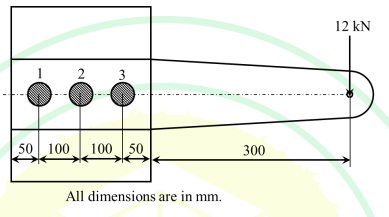
A steel plate is fastened to a channel using three identical bolts as shown in the figure. The bolts are made of carbon steel of permissible yield strength in shear as $400 \text{ N/mm}^2$. The plate is subjected to a force of 12 kN. Neglect the weight of the plate. The magnitude of the resultant shear force (in N) on bolt 2 is __________. (Answer in integer)
Based upon governing equation for the theory of pure bending which of the following is valid
What is the value of the ratio between maximum shear stress to average shear stress for a circular section?
A beam is said to be pure bending, when


