
Rahul was looking for his coach. He went 80 m in the east before turning to his right. He went 10 m before turning to his right again and then went 20 m away from that point. From there he went 90 m to the north before meeting his coach in a ground. What was the smallest distance between the starting point and the position of his coach?
100 m
Calculating Shortest Distance Using Displacement
This problem asks us to find the shortest distance between Rahul's starting point and the point where he meets his coach. This shortest distance is also known as the displacement. To find the displacement, we need to determine Rahul's net change in position both horizontally (East-West) and vertically (North-South) from his origin.
Let's break down Rahul's movements step by step:
- Rahul starts at a point. Let's consider this as the origin (0, 0) on a coordinate system, where East is the positive x-direction and North is the positive y-direction.
- He goes 80 m in the east. His position changes from (0, 0) to (80, 0).
- He turns to his right (which is South from East) and goes 10 m. His position changes from (80, 0) to (80, -10). Moving South means moving in the negative y-direction.
- He turns to his right again (which is West from South) and goes 20 m away from that point. His position changes from (80, -10) to (80 - 20, -10) = (60, -10). Moving West means moving in the negative x-direction.
- From there, he went 90 m to the north before meeting his coach. His position changes from (60, -10) to (60, -10 + 90) = (60, 80). Moving North means moving in the positive y-direction.
So, Rahul's final position where he meets his coach is at the coordinates (60, 80), relative to his starting point (0, 0).
To find the shortest distance between the starting point (0, 0) and the final point (60, 80), we can use the distance formula, which is derived from the Pythagorean theorem. The displacement is the hypotenuse of a right-angled triangle formed by the net displacement in the x-direction and the net displacement in the y-direction.
Net displacement in the x-direction = Final x-coordinate - Starting x-coordinate = \(60 - 0 = 60\) m.
Net displacement in the y-direction = Final y-coordinate - Starting y-coordinate = \(80 - 0 = 80\) m.
Shortest distance (displacement) = \(\sqrt{(\text{Net x-displacement})^2 + (\text{Net y-displacement})^2}\)
Shortest distance = \(\sqrt{(60\text{ m})^2 + (80\text{ m})^2}\)
Shortest distance = \(\sqrt{3600\text{ m}^2 + 6400\text{ m}^2}\)
Shortest distance = \(\sqrt{10000\text{ m}^2}\)
Shortest distance = \(100\) m.
Let's summarize the movements and final position in a table:
| Step | Direction | Distance (m) | Change in X (m) | Change in Y (m) | Current Position (X, Y) |
|---|---|---|---|---|---|
| Start | - | - | 0 | 0 | (0, 0) |
| 1 | East | 80 | +80 | 0 | (80, 0) |
| 2 | South (Right turn from East) | 10 | 0 | -10 | (80, -10) |
| 3 | West (Right turn from South) | 20 | -20 | 0 | (60, -10) |
| 4 | North | 90 | 0 | +90 | (60, 80) |
| Total Displacement Components | +60 | +80 | (60, 80) | ||
The coordinates of the final meeting point relative to the starting point are (60, 80). Using the Pythagorean theorem:
Distance = \(\sqrt{60^2 + 80^2} = \sqrt{3600 + 6400} = \sqrt{10000} = 100\) m.
The smallest distance between the starting point and the position of his coach is 100 m.
Revision Table: Key Concepts
| Concept | Description |
|---|---|
| Displacement | The shortest straight-line distance between the initial and final positions of an object. It is a vector quantity (has magnitude and direction). |
| Distance | The total length of the path traveled by an object. It is a scalar quantity (only has magnitude). |
| Pythagorean Theorem | In a right-angled triangle, the square of the hypotenuse (the side opposite the right angle) is equal to the sum of the squares of the other two sides (\(a^2 + b^2 = c^2\)). Useful for finding displacement on a 2D plane. |
| Coordinate System | A system using one or more coordinates to uniquely determine the position of a point or other geometric element on a manifold such as Euclidean space. Here, a 2D (x, y) system is used. |
Additional Information: Displacement vs. Distance Traveled
It is important to distinguish between distance traveled and displacement in physics and motion problems.
- Distance Traveled: This is the sum of the lengths of all segments Rahul traveled. In this case, the total distance traveled would be \(80\text{ m} + 10\text{ m} + 20\text{ m} + 90\text{ m} = 200\text{ m}\). This is the total path length.
- Displacement: This is the straight-line distance from the starting point to the ending point. It only depends on the initial and final positions, not the path taken. In this problem, the displacement is 100 m.
The question specifically asks for the "smallest distance between the starting point and the position of his coach," which refers to the displacement. This is why we use the Pythagorean theorem on the net changes in position rather than adding up all the segments.
Similar Questions
- Ramesh wants to visit his childhood friend’s house. Ramesh’s friend explained his house directions over a text message. See the below text sent to Ramesh about the direction of his friend’s house and answer the following question accordingly.“When you step out of your house, you are facing north. Take a right and walk 3 km, you will see a T-point/junction. Take a right and walk 2 km. There will be a roundabout with four roads. Take the second left from the roundabout and walk 1 km. Take a right and walk 3 km. Take a right and walk 1 km. You will find my house at the front.”How many kilometres did Ramesh walk till the roundabout?
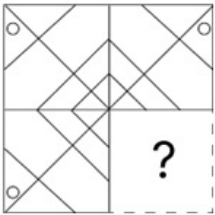
Select the figure from the options that can replace the question mark (?) and complete the given pattern.
In morning after sunrise, a boy rode his bicycle 4 km towards North then he took right turn and rode 6 km then he took left turn and rode 5 km to reach his school. In which direction the starting point is with respect to location of School?
Town P is to the East of town Q. Town R is to the South of town P. Town T is to the West of town R. Town P is towards which direction of town T?
In a certain coded language.
@ means East
# means West
means North
! means South
For example,
*@means North-East
Mr. Rajan started from his house and moves towards East. After walking for a distance of 20 m, he took aright turn, and walks for 20 m. Then he took a left turn and walk for 15 m. After that he took a right turn and walked 15 m more towards his office. In which direction Mr. Rajan facing now?A policeman stepped out of the police station and walked 60 m towards west. He then took a left turn walked 38 m to reach a fruit shop. He then took a right turn and walked 60 m. He then took a right turn and walked 38 m to reach a restaurant. What is the approximate shortest distance between the police station and the restaurant via the fruit shop?
Malini went from her office to the bank. She started her journey facing West. First, she went 2 km straight; then she turned to her right and went 3 km; finally, she turned left and walked 2 km to reach the bank.
What is the shortest distance between Malini’s office and the bank?VD Raman’s house is 30 m to the left of a temple, which is 40 m to the north of church. One day, VD Raman starts from his house and takes the roads which is parallel to the temple-church road and walks 50 m before turning to his right. He further walks 20 m and reaches a gym.
What is difference between the straight distance between VD Raman’s house and the church and the temple and the gym?In morning after sunrise a boy rode his bicycle 4 km towards the north. The he took right turn and rode 6 km. Then he took left turn and rode 5 km to reach his school. In which direction the school is with respect to the starting point?
Dr. Mruhula walks 24 m east from point A and reaches point B in Apollo hospital. From point B she takes left turn and walks 8 m and then she takes right turn and walked 12 m and again she takes right turn and walks 14 m and again takes right turn and reaches point M. If it is given that the starting point is in north from point where she ends her journey. Then what is the distance between the point A and M.
Important Questions from Direction and Distance
- Johny starts from Point A and drives 6 km towards the North. He then takes a right turn, drives 17 km, turns right and drives 13 km. He then takes a right turn and drives 8 km. He takes a final right turn, drives 7 km and stops at Point P. How far (shortest distance) and towards which direction should he drive to reach Point A again? (All turns are 90 degrees turns only unless specified.)
- Town Q is to the east of Town P. Town R is to the south of Town Q. Town S is to the east of Town R. Town T is to the south of Town S. Town U is to the east of Town T. What is the position of Town U with respect to Town Q?
- Binoy starts from Point Y and drives 16 km towards the north. He then takes a right turn and drives 43 km, then turns right and drives 38 km. He then takes a right turn and drives 19 km. He takes a final right turn, drives 22 km and stops at Point Z. How far (shortest distance) and in which direction should he drive in order to reach Point Y again? (All turns are 90-degree turns only unless specified.)
- Himank starts from Point A and drives 13 km towards West. He then takes a left turn, drives 3 km, turns left and drives 16 km. He then takes a left turn and drives 6 km. He takes a final left turn, drives 3 km and stops at Point P. How far (shortest distance) and towards which direction should he drive in order to reach Point A again? (All turns are 90° turns only unless specified.)
- Shyam starts from Point A and drives 12 km towards east. He then takes a right turn,
drives 7 km, turns right and drives 5 km. He then takes a left turn and drives 9 km. He
takes a final right turn, drives 7 km and stops at Point P. How far (shortest distance) and
towards which direction should he drive in order to reach Point A again? (All turns are
$90^{\circ}$ turns only unless specified.)



