
P and Q are children of S. Who is the father of P? To answer this question which of the statements (1) and (2) is/are necessary?
(1) R is the brother of P and the son of T.
(2) U is the mother of Q.
Evaluating Statements for Family Relationship Question
The objective is to find the father of P. We know P and Q are children of S.
Analysis of Statement (1)
- Statement (1) states that R is the brother of P and the son of T.
- This establishes that P and R are siblings.
- It also indicates that T is a parent of R. Since P and R are siblings, T is also a parent of P. T being a "son" implies T is male.
- However, the question mentions S is a parent of P. Statement (1) does not clarify the relationship between S and T, nor does it confirm T as the father of P.
- Therefore, Statement (1) alone is not sufficient.
Analysis of Statement (2)
- Statement (2) states that U is the mother of Q.
- Given that P and Q are children of S, they are siblings.
- If U is the mother of Q, then U is also the mother of P.
- Since S is a parent of P and U is the mother, S must necessarily be the father of P.
- Therefore, Statement (2) alone is sufficient.
Conclusion: To determine the father of P, only Statement (2) is required.
Important Questions from Data Sufficiency (Notes)
- In light of the statements I and II choose the most appropriate option.
If a group comprises of five persons A, B, C, D and E, then how many persons are taller than E?
Statement (I) A is taller than B and B is shorter than A and E only.
Statement (II) C is shorter than A and A is shorter than E. - In light of the statements I and II choose the most appropriate option.
Eight boxes- A, B, C, D, P, Q, R and S are stacked vertically but not necessarily in the same order. Which among them is kept immediately above R?
Statement (I) Only three boxes are kept above D and only one box is kept between D and Q. Q is kept lower than D and is immediately below P.
Statement (II) Only one box is kept between A and C. C is kept three boxes above Q. As many boxes are kept above B as are kept below R. A question along with a set of statements is given below. We have to find which of the given statements is/are sufficient to answer the given question.
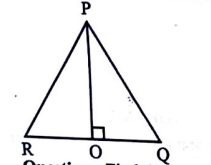
Question : Find the area of the triangle PQR.
Statements :
I. PQ = 5 m., PR = 5 m.
II. Length of PO is 4 m.Given below is a question followed by two statements, I and II, each containing some information. Decide which of the statements are sufficient to answer the question. The difference between father's age and son's age is 21 years now. What is the present age of the son?
Statements
I. After five years, the ratio of father's age to that of the son would be 5:2.
II. The sum of father's age and son's age after five years would be 66 years.Given below is a question followed by two statements, I and II, each containing some information. Decide which of the statements are sufficient to answer the question.
Question:
Rajesh's salary is Rs. 12,500. What is Arvind's salary?
Statements
I. Arvind gets $\frac{3}{5}$th of the total salary of his and Rajesh'
II. Two-thirds of Arvind's salary is equal to the average salary of both.


