Selection Constraining Rhinoceros Beetle Horn Growth
The constraint on rhinoceros beetle horn length, where it never exceeds two-thirds of their body length despite the advantage of larger horns for fighting, is best explained by stabilizing selection.
Understanding Stabilizing Selection
Stabilizing selection occurs when natural selection favors intermediate phenotypes over extreme ones. In the case of the beetles:
- Very large horns might offer a fighting advantage but could also impose significant costs, such as being too heavy, unwieldy, or increasing susceptibility to predation.
- Very small horns would be disadvantageous in fights.
- Therefore, selection favors horn lengths that are intermediate – large enough to be effective but not so large as to incur excessive costs. This pressure maintains the horn length within a specific range, preventing it from reaching extreme sizes relative to body length.
Why Other Selections Don't Fit
- Directional selection would push the horn length towards one extreme (e.g., consistently longer horns).
- Disruptive selection would favor both very short and very long horns, potentially leading to a bimodal distribution, which is contrary to the observed constraint.
- Artificial selection is driven by human choice, not natural environmental or competitive pressures acting on the beetle population.
Thus, the upper limit on horn length indicates that extreme horn sizes are selected against, which is the hallmark of stabilizing selection.
Important Questions from Stabilizing selection
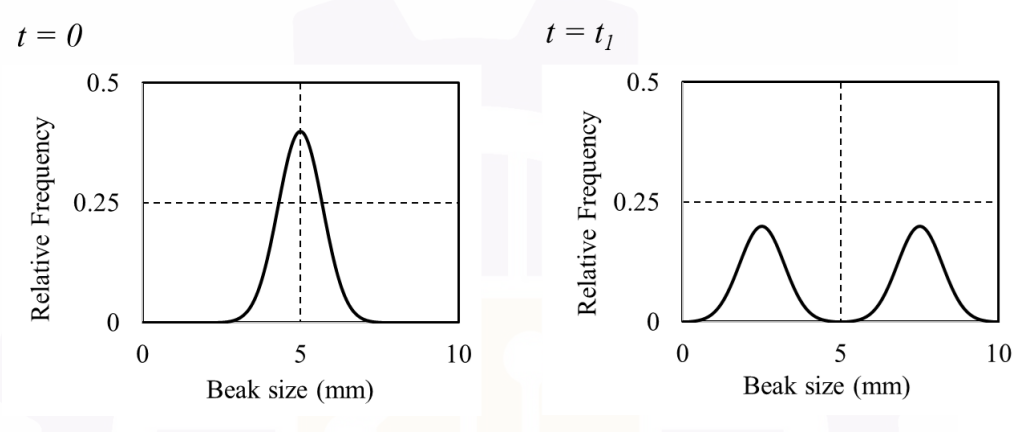
The distributions of beak size in a bird population at two different times are shown below. In going from time $t = 0$ to $t = t_1$, the variance of the distribution in beak size in the population has _________.
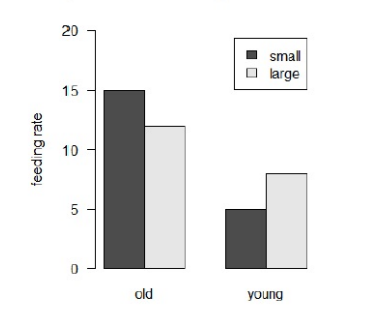
The figure below shows how feeding rate varies with age (old/young) and with body size (small/large) in males of a deer species. Based on this figure, which of the statements below is FALSE?
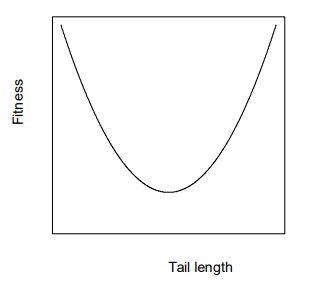
The figure below shows how reproductive fitness varies with tail length in a bird species. Given this pattern, what kind of selection is most likely to act on tail length in this population?