
In which of the following modes does a photodiode work?
Reverse bias
Photodiode Working Mode Explained
A photodiode is a specialized semiconductor device designed to convert light energy into electrical current. It operates based on the principle of the photoelectric effect, where photons striking the device generate electron-hole pairs, leading to a flow of current.
Understanding Photodiode Bias Conditions
Diodes, including photodiodes, can be operated in two primary bias conditions: forward bias and reverse bias.
- Forward Bias: In forward bias, the positive terminal of the voltage source is connected to the p-type material and the negative terminal to the n-type material. This reduces the width of the depletion region, allowing a large current to flow easily through the diode. For a photodiode, this large forward current would overwhelm the small photocurrent generated by light, making it difficult to detect changes in light intensity. Therefore, photodiodes are generally not operated in forward bias for light detection.
- Reverse Bias: In reverse bias, the positive terminal of the voltage source is connected to the n-type material and the negative terminal to the p-type material. This increases the width of the depletion region, creating a strong electric field across it. In this state, only a very small current, known as "dark current," flows in the absence of light.
Operation of Photodiode in Reverse Bias
When a photodiode is operated in reverse bias and incident light (photons) strikes its depletion region, the following phenomena occur:
- Electron-Hole Pair Generation: Photons with sufficient energy (greater than the bandgap of the semiconductor material) are absorbed within or near the depletion region. This absorption creates electron-hole pairs.
- Carrier Collection: The strong electric field across the wide depletion region rapidly sweeps these newly generated electron-hole pairs apart. Electrons are swept towards the n-side, and holes are swept towards the p-side.
- Photocurrent Generation: This movement of charge carriers constitutes an electric current, known as the "photocurrent." The magnitude of this photocurrent is directly proportional to the intensity of the incident light.
- Low Dark Current: Because the photodiode is reverse biased, the intrinsic current (dark current) is very small. This low dark current ensures that the photocurrent, even if small, is easily detectable and not masked by background current, providing high sensitivity to light.
- Fast Response: The strong electric field in the reverse-biased depletion region allows for a rapid collection of photo-generated carriers, leading to a fast response time, which is crucial for applications like optical communication.
Therefore, for efficient and sensitive detection of light, a photodiode is always operated in the reverse bias mode. This mode allows it to function as a light detector, converting varying light intensity into a measurable electrical current.
Important Questions from Diodes and Its Applications
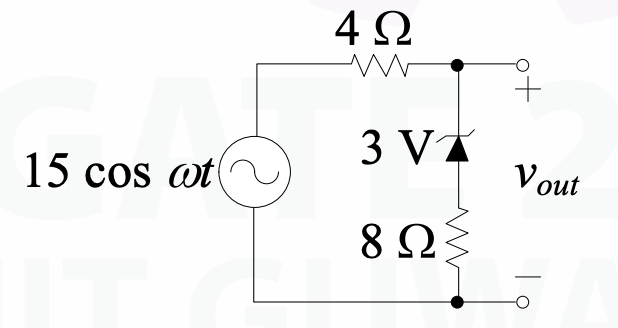
In the circuit below the maximum value of $v_{\text{out}}$ is ________ V. (rounded off to the nearest integer)
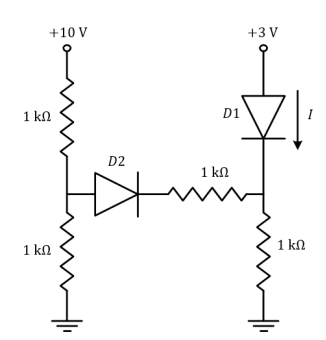
In the given circuit, the diodes are ideal. The current $I$ through the diode D1 in milliamperes is ______________ (rounded off to two decimal places).
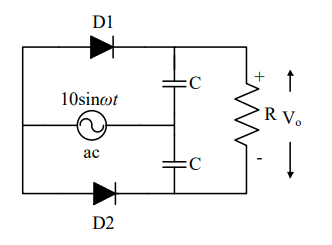
The diodes D1 and D2 in the figure are ideal and the capacitors are identical. The product RC is very large compared to the time period of the ac voltage. Assuming that the diodes do not breakdown in the reverse bias, the output voltage $V_o$ (in volt) at the steady state is _________
In a full wave rectifier without filter, the ripple factor is
12 V DC and 24 V DC are general operating voltages for:


