
In the circuit below the maximum value of $v_{\text{out}}$ is ________ V. (rounded off to the nearest integer) 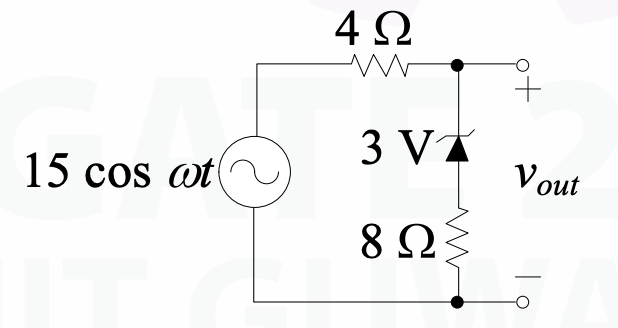
Detailed Solution
To find the maximum value of the output voltage \( v_{\text{out}} \), we need to analyze the circuit during the positive peak of the input signal.
1. Identify the Input Signal
The input voltage is given as:
$$ v_{\text{in}}(t) = 15 \cos \omega t $$
The maximum (peak) value of the input voltage is \( V_{p} = 15 \) V.
2. Analyze the Circuit for the Positive Half-Cycle
When \( v_{\text{in}} \) is positive, the top terminal of the AC source is at a higher potential than the bottom terminal. In this condition:
- The Zener diode is in reverse bias.
- The Zener diode will enter the breakdown region if the voltage across it exceeds its Zener voltage (\( V_Z = 3 \) V).
- Since the peak input is 15 V, which is significantly higher than the Zener voltage, the diode acts as a constant voltage source of \( 3 \) V in series with the \( 8 \, \Omega \) resistor.
3. Calculation of Output Voltage (\( v_{\text{out}} \))
During the positive peak (\( v_{\text{in}} = 15 \) V), the circuit consists of the \( 4 \, \Omega \) resistor in series with the Zener branch (the Zener diode and the \( 8 \, \Omega \) resistor). We can find the output voltage using the node voltage method or current calculation.
Method 1: Using Kirchhoff's Current Law (KCL) at the output node
Let the voltage at the output node be \( v_{\text{out}} \). Applying KCL:
$$ \frac{15 - v_{\text{out}}}{4} = \frac{v_{\text{out}} - 3}{8} $$
Multiply both sides by 8 to clear the denominators:
$$ 2(15 - v_{\text{out}}) = v_{\text{out}} - 3 $$ $$ 30 - 2v_{\text{out}} = v_{\text{out}} - 3 $$ $$ 33 = 3v_{\text{out}} $$ $$ v_{\text{out}} = 11 \text{ V} $$
Method 2: Using the Series Current
The total current \( I \) in the circuit during the peak is:
$$ I = \frac{V_{\text{in}} - V_Z}{R_1 + R_2} = \frac{15 - 3}{4 + 8} = \frac{12}{12} = 1 \text{ A} $$
The output voltage is the voltage across the Zener branch:
$$ v_{\text{out}} = V_Z + (I \times 8 \, \Omega) = 3 + (1 \times 8) = 11 \text{ V} $$
4. Conclusion
During the negative half-cycle, the Zener diode will be forward-biased (acting like a standard diode with a drop of approximately \( 0.7 \) V), resulting in a negative output voltage. Therefore, the absolute maximum value occurs during the positive peak.
The maximum value of \( v_{\text{out}} \) is 11 V.
Important Questions from Diodes and Its Applications
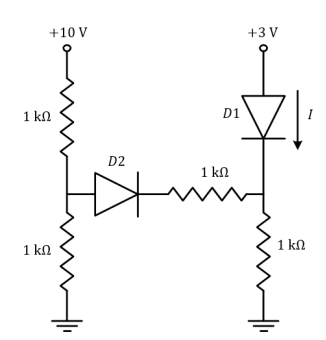
In the given circuit, the diodes are ideal. The current $I$ through the diode D1 in milliamperes is ______________ (rounded off to two decimal places).
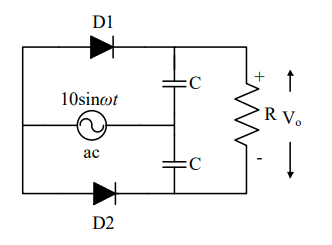
The diodes D1 and D2 in the figure are ideal and the capacitors are identical. The product RC is very large compared to the time period of the ac voltage. Assuming that the diodes do not breakdown in the reverse bias, the output voltage $V_o$ (in volt) at the steady state is _________
In a full wave rectifier without filter, the ripple factor is
In which of the following modes does a photodiode work?
12 V DC and 24 V DC are general operating voltages for:


