
$$ \frac{d\sigma}{d(\cos\theta)} = \left| \sum_l (2l+1)e^{i\delta_l} \sin\delta_l P_l(\cos\theta) \right|^2 $$
where $\theta$ is the scattering angle. For a certain neutron-nucleus scattering, it is found that the two lowest phase shifts $\delta_0$ and $\delta_1$ corresponding to $s$-wave and $p$-wave, respectively, satisfy $\delta_1 \approx \delta_0/2$. Assuming that the other phase shifts are negligibly small, the differential cross-section reaches its minimum for $\cos\theta$ equal to
Partial Wave Expansion Cross-Section Analysis
The differential scattering cross-section calculation involves the partial wave expansion formula:
$ \frac{d\sigma}{d(\cos\theta)} = \left| \sum_l (2l+1)e^{i\delta_l} \sin\delta_l P_l(\cos\theta) \right|^2 $For neutron-nucleus scattering, we consider the low energy approximation where only the $s$-wave ($\delta_0$) and $p$-wave ($\delta_1$) phase shifts are significant. Thus, $\delta_l \approx 0$ for $l \ge 2$. We are also given the condition $\delta_1 \approx \delta_0 / 2$.
Simplified Cross-Section Calculation
With only $l=0$ and $l=1$ terms contributing, and using $P_0(\cos\theta) = 1$ and $P_1(\cos\theta) = \cos\theta$, the cross-section simplifies to:
$ \frac{d\sigma}{d(\cos\theta)} \approx \left| (2(0)+1)e^{i\delta_0} \sin\delta_0 P_0(\cos\theta) + (2(1)+1)e^{i\delta_1} \sin\delta_1 P_1(\cos\theta) \right|^2 $ $ \frac{d\sigma}{d(\cos\theta)} \approx \left| e^{i\delta_0} \sin\delta_0 + 3e^{i\delta_1} \sin\delta_1 \cos\theta \right|^2 $Let $x = \cos\theta$. Expanding the squared magnitude gives a quadratic function of $x$:
$ \frac{d\sigma}{d(\cos\theta)} = \sin^2\delta_0 + 9\sin^2\delta_1 x^2 + 6 \sin\delta_0 \sin\delta_1 \cos(\delta_0 - \delta_1) x $Finding the Minimum Condition
The expression is a quadratic $f(x) = C_2 x^2 + C_1 x + C_0$, where $C_2 = 9\sin^2\delta_1$ and $C_1 = 6 \sin\delta_0 \sin\delta_1 \cos(\delta_0 - \delta_1)$. The minimum occurs where the derivative with respect to $x$ is zero:
$ \frac{df}{dx} = 2C_2 x + C_1 = 0 $ $ x = -\frac{C_1}{2C_2} = -\frac{6 \sin\delta_0 \sin\delta_1 \cos(\delta_0 - \delta_1)}{2 \times 9\sin^2\delta_1} $ $ \cos\theta = -\frac{\sin\delta_0 \cos(\delta_0 - \delta_1)}{3\sin\delta_1} $Applying Phase Shift Approximation
We use the given approximation $\delta_0 \approx 2\delta_1$. Substituting this into the expression for $\cos\theta$:
$ \cos\theta \approx -\frac{\sin(2\delta_1) \cos(2\delta_1 - \delta_1)}{3\sin\delta_1} $Using the identity $\sin(2\delta_1) = 2\sin\delta_1\cos\delta_1$:
$ \cos\theta \approx -\frac{(2\sin\delta_1 \cos\delta_1) \cos(\delta_1)}{3\sin\delta_1} $Assuming $\sin\delta_1 \neq 0$, we simplify to find the value of $\cos\theta$ at the minimum:
$ \cos\theta \approx -\frac{2\sin\delta_1 \cos^2\delta_1}{3\sin\delta_1} = -\frac{2}{3}\cos^2\delta_1 $Important Questions from Scattering Theory
- A phase shift of $30^\circ$ is observed when a beam of particles of energy $0.1$ MeV is scattered by a target. When the beam energy is changed, the observed phase shift is $60^\circ$. Assuming that only s-wave scattering is relevant and that the cross-section does not change with energy, the beam energy is
- Consider the potential
$$V(\vec{r}) = \sum_i V_0 a^3 \delta^{(3)}(\vec{r} - \vec{r}_i)$$
where $\vec{r}_i$ are the position vectors of the vertices of a cube of length $a$ centered at the origin and $V_0$ is a constant. If $V_0 a^2 \ll \frac{\hbar^2}{m}$, the total scattering cross-section, in the low-energy limit, is - A particle of energy $E$ scatters off a repulsive spherical potential
$V(r) = \begin{cases} V_0 & \text{for } r < a \\ 0 & \text{for } r \ge a \end{cases}$
where $V_0$ and $a$ are positive constants. In the low energy limit, the total scattering cross-section is $\sigma = 4\pi a^2 \left(\frac{1}{ka}\tanh ka - 1\right)^2$, where $k^2 = \frac{2m}{\hbar^2}(V_0 - E) > 0$. In the limit $V_0 \to \infty$ the ratio of $\sigma$ to the classical scattering cross-section off a sphere of radius $a$ is - The range of the inter-atomic potential in gaseous hydrogen is approximately $5\text{ \AA}$. In thermal equilibrium, the maximum temperature for which the atom-atom scattering is dominantly $s$-wave, is
A particle of mass $m$ and energy $E > 0$, in one dimension is scattered by the potential shown below.
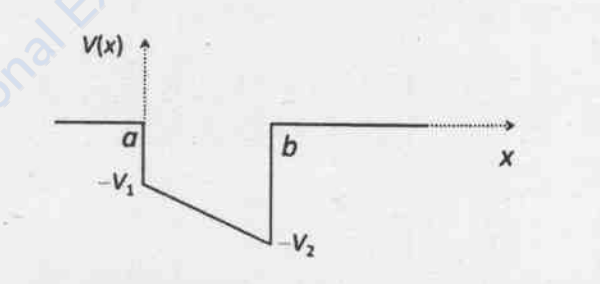
If the particle was moving from $x = -\infty$ to $x = \infty$, which of the following graphs gives the best qualitative representation of the wavefunction of this particle?


