
Question
In the IUGS classification diagram for mafic and ultramafic rocks shown below, choose the correct option for the rocks labelled X and Y.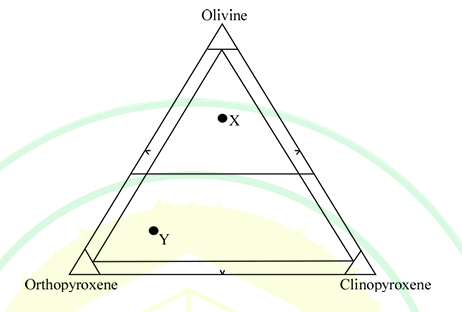
The correct answer is
X: Lherzolite and Y: Olivine Websterite
The IUGS classification diagram for mafic and ultramafic rocks is a ternary diagram used to classify these rocks based on their mineral content. The three corners of the triangle represent major minerals: Olivine, Orthopyroxene, and Clinopyroxene. In the given diagram, the positions of the rocks labeled 'X' and 'Y' need to be identified correctly.
Let's analyze the positions:
- Rock X is closer to the Olivine corner but has a significant presence of both Orthopyroxene and Clinopyroxene. In the IUGS classification, a rock with significant Olivine, and balanced amounts of Orthopyroxene and Clinopyroxene, is classified as Lherzolite.
- Rock Y is situated between Orthopyroxene and Clinopyroxene but closer to Clinopyroxene while containing Olivine. This combination fits the classification of Olivine Websterite, which characteristically contains olivine in addition to the pyroxenes.
Let's evaluate the given options:
- X: Harzburgite and Y: Olivine Websterite - Harzburgite would have more Olivine and Orthopyroxene, placing it further from the Clinopyroxene corner, so this is not correct for X.
- X: Lherzolite and Y: Olivine Websterite - This matches our analysis, as described above.
- X: Dunite and Y: Clinopyroxenite - Dunite contains almost entirely Olivine. X has significant Orthopyroxene and Clinopyroxene, making this incorrect.
- X: Anorthosite and Y: Wehrlite - These are incorrect: Anorthosite is a plagioclase-rich rock, not fitting the ternary minerals, and Wehrlite would be Olivine-rich with Clinopyroxene but not orthopyroxene, inconsistent with X's position.
Therefore, the correct classification is:
X: Lherzolite and Y: Olivine Websterite
Was this answer helpful?
Important Questions from Petrology (Ultramafic Rock Identification)
- Which one of the following is an ultramafic rock?
- A coarse-grained igneous rock consists of 55% olivine, 25% augite and 20% enstatite. According to the IUGS classification, the rock is
- The dominant constituent of ultramafic rocks in the earth's mantle is
Need Expert Advice?


