
Key Mineral Composition
The coarse-grained igneous rock has the following modal mineralogy:
- Olivine: 55%
- Augite (Clinopyroxene): 25%
- Enstatite (Orthopyroxene): 20%
IUGS Classification Criteria
The International Union of Geological Sciences (IUGS) classification for ultramafic rocks, based on modal mineralogy (percentages of key minerals), is used here. The critical minerals for this classification are Olivine (Ol), Clinopyroxene (CPx), and Orthopyroxene (OPx).
- Rocks dominated by olivine (more than 40%) are classified based on the ratio of pyroxenes.
- Lherzolite is defined as having >40% Olivine, significant amounts of both Clinopyroxene and Orthopyroxene (sum > 10%), and where Clinopyroxene is more abundant than Orthopyroxene (CPx > OPx).
- Harzburgite has >40% Olivine and Orthopyroxene is more abundant than Clinopyroxene (OPx > CPx).
- Wehrlite has >40% Olivine and Clinopyroxene is dominant, with Orthopyroxene being minor.
- Websterite is predominantly composed of pyroxenes (CPx + OPx) with less than 40% Olivine.
Rock Identification
Based on the given composition:
- Olivine content is 55%, which is greater than 40%. This indicates an olivine-rich ultramafic rock.
- The sum of pyroxenes (Augite + Enstatite) is 25% + 20% = 45%, which is significant (greater than 10%).
- Comparing the pyroxenes: Augite (CPx) = 25% and Enstatite (OPx) = 20%. Since 25% > 20%, Clinopyroxene is more abundant than Orthopyroxene.
This combination of >40% Olivine, significant amounts of both CPx and OPx, and CPx > OPx, aligns precisely with the definition of Lherzolite according to the IUGS classification.
Important Questions from Petrology (Ultramafic Rock Identification)
In the IUGS classification diagram for mafic and ultramafic rocks shown below, choose the correct option for the rocks labelled X and Y.
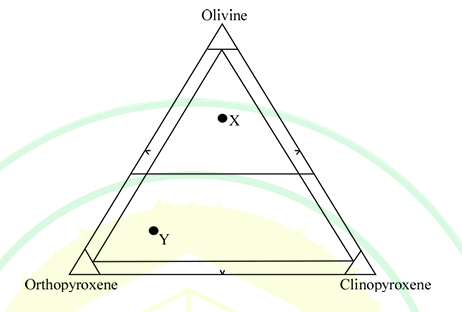
- Which one of the following is an ultramafic rock?
- The dominant constituent of ultramafic rocks in the earth's mantle is


