
In the circuit of an Op-Amp as an integrator, the feedback circuit mainly contains a ______.
Capacitor
An ideal Integrator circuit is shown below:
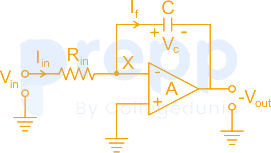
It is clear from the circuit diagram of the integrator, the feedback element is a Capacitor .
Note:
At high frequencies, the capacitor is a short circuit so the output is 0.
At low frequencies, the capacitor is an open circuit, the output voltage is the amplified input voltage(the output is non-zero).
thus an ideal integrator acts as a low pass filter.
 Important Points
The feedback path in an op-amp differentiator consists of a resistor.
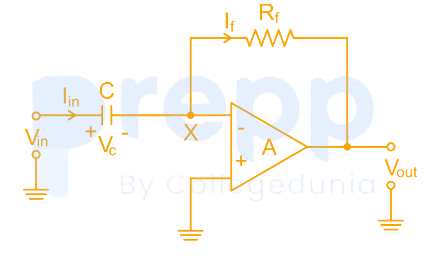
At high frequencies, the capacitor is a short circuit so the output is the amplified input voltage(the output is non-zero)
At low frequencies, the capacitor is an open circuit, the output voltage is 0.
thus an ideal Differentiator acts as a High pass filter.
Similar Questions
The Common Mode Rejection Ratio (CMRR) of an ideal OP-Amp is ________.
- In an operational amplifier integrator circuit, which component acts as feedback between the output and the input?
Which operational amplifier configuration is commonly used in zero crossing detectors?
If the input resistor of an inverting amplifier using OP-AMP is doubled and the feedback resistor remains the same, what happens to the magnitude of voltage gain?
To convert an op-amp integrator into a practical integrator (avoiding low-frequency saturation), which component is typically added in parallel with the feedback capacitor?
When analyzing a closed-loop circuit containing an ideal operational amplifier, what assumption must be applied regarding the currents entering the inverting and non-inverting input pins?
What happens to the gain of a non-inverting amplifier using OP-AMP if the feedback resistor value is increased by 5 % while keeping the input resistor constant? (Assuming the OP-AMP remains in linear range for operation.)
Important Questions from Operational Amplifiers
Which one of the following options is true for an ideal Op-amp?
An instrumentation amplifier has a high
An OP-Amp is designed to amplify:
The Common Mode Rejection Ratio (CMRR) of an ideal OP-Amp is ________.
- In an operational amplifier integrator circuit, which component acts as feedback between the output and the input?



