
In an examination, 45 percent of students passed in history and 60 percent of students passed in Hindi. If 8 percent of students failed in both subjects, then what percentage of students passed in both subjects?
13 percent
Understanding the Student Percentage Problem
This problem deals with percentages of students who passed or failed in two subjects: History and Hindi. We are given the percentage of students who passed in each subject individually and the percentage who failed in both. We need to find the percentage of students who passed in both subjects.
Let's break down the information given:
- Percentage of students who passed in History = 45%
- Percentage of students who passed in Hindi = 60%
- Percentage of students who failed in both History and Hindi = 8%
The total percentage of students is always 100%.
Calculating Total Pass Percentage
If 8% of students failed in both subjects, it means the remaining percentage of students passed in at least one subject (either History, or Hindi, or both). This total percentage represents those who did NOT fail in both.
Percentage of students who passed in at least one subject = Total students - Percentage who failed in both
Percentage who passed in at least one subject = $100\% - 8\%$
Percentage who passed in at least one subject = $92\%$
This 92% includes students who passed in History only, students who passed in Hindi only, and students who passed in both History and Hindi.
Finding Percentage Passed in Both Subjects
We can use the principle of inclusion-exclusion, often visualized with a Venn diagram, to solve this. For two sets, the total number of elements in their union is the sum of elements in each set minus the number of elements in their intersection.
In terms of percentages of students passing:
Percentage passed in (History or Hindi or Both) = Percentage passed in History + Percentage passed in Hindi - Percentage passed in (History and Hindi)
We already know the percentage who passed in at least one subject (History or Hindi or Both) is 92%.
So, we can write the equation:
$92\% = 45\% + 60\% - \text{Percentage passed in both}$
Now, we need to find the Percentage passed in both subjects. Let's rearrange the equation:
Percentage passed in both = $45\% + 60\% - 92\%$
Percentage passed in both = $105\% - 92\%$
Percentage passed in both = $13\%$
Therefore, 13 percent of the students passed in both History and Hindi.
Summary of Calculation Steps
| Step | Description | Calculation | Result |
|---|---|---|---|
| 1 | Find percentage passed in at least one subject. | $100\% - 8\%$ | $92\%$ |
| 2 | Use the inclusion-exclusion principle formula. | $\text{Passed in both} = (\text{Passed in History}) + (\text{Passed in Hindi}) - (\text{Passed in at least one})$ | |
| 3 | Substitute values and calculate. | $45\% + 60\% - 92\%$ | $13\%$ |
Revision Table: Key Concepts
| Concept | Explanation | Relation to Problem |
|---|---|---|
| Total Percentage | Represents the whole, always 100% of the students. | Used as the base for calculations. |
| Passed in Both | Students who cleared exams in History AND Hindi. This is the intersection. | What we need to find. |
| Failed in Both | Students who did NOT clear exams in History AND did NOT clear in Hindi. This is the complement of 'passed in at least one'. | Given value, used to find 'passed in at least one'. |
| Passed in At Least One | Students who cleared History OR Hindi OR both. This is the union. | Calculated from 'failed in both', used in the main formula. |
| Inclusion-Exclusion Principle | Formula relating the union of sets to the sum of individual sets minus their intersection. | The core method used to solve the problem. |
Additional Information: Venn Diagrams and Percentages
Visualizing this problem with a Venn diagram can be helpful. Imagine two overlapping circles, one for History passers and one for Hindi passers, inside a rectangle representing all students (100%).
- The overlapping area represents students who passed in both subjects. This is what we want to find.
- The parts of the circles that do not overlap represent students who passed only in History and students who passed only in Hindi.
- The area outside both circles represents students who failed in both subjects (8%).
The percentage of students who passed in at least one subject (92%) covers everything inside the two circles (the union of the two sets).
The formula we used, $\text{P(A } \cup \text{ B) = P(A) + P(B) - P(A } \cap \text{ B)}$, directly relates the parts of this Venn diagram:
- $\text{P(A } \cup \text{ B)}$ is the total area covered by the circles (92%).
- $\text{P(A)}$ is the History circle (45%).
- $\text{P(B)}$ is the Hindi circle (60%).
- $\text{P(A } \cap \text{ B)}$ is the overlap (percentage passed in both).
By adding P(A) and P(B), we count the overlap area twice. Subtracting the overlap once corrects this double counting to give the total area of the union.
Important Questions from Venn Diagram
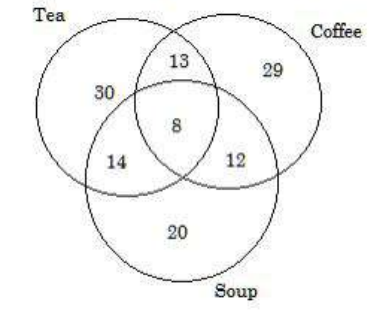
The following Venn diagram shows people’s liking for Tea, Coffee, and Soup. How many people like tea and coffee both?
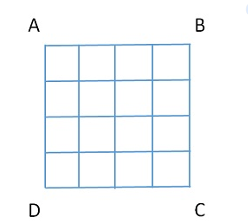
How many squares are there in the square figure ABCD?
Identify the diagram that best represents the relationship among classes given below: Men, Rodents and living beings
In a company of 1000 employees, 760 can speak Hindi and 430 can speak English. How many people can speak only Hindi, only English and both Hindi and English, respectively?
Study the given Venn diagram carefully and answer the question that follows.
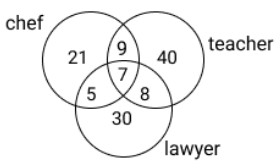
The numbers in different sections indicate the number of persons. How many chefs are there who are also teachers but not lawyers?


