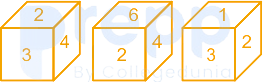
In a dice, each face is numbered as follows: 1) 3 is opposite to 6 2) 4 is opposite to 5 3) 2 is opposite to 1 Which of the following is definitely false?
4 is not adjacent to 3 and 6
Dice Opposite Faces Analysis
The problem describes the opposite face pairings for a specific six-sided die:
- Face 3 is opposite to Face 6 ($3 \leftrightarrow 6$)
- Face 4 is opposite to Face 5 ($4 \leftrightarrow 5$)
- Face 2 is opposite to Face 1 ($2 \leftrightarrow 1$)
Determining Adjacent Faces
For any standard die, a face has 4 adjacent faces and 1 opposite face. We can deduce the adjacent faces from the given opposite pairs:
- Faces adjacent to 3 and 6 are {1, 2, 4, 5}.
- Faces adjacent to 4 and 5 are {1, 2, 3, 6}.
- Faces adjacent to 2 and 1 are {3, 4, 5, 6}.
Evaluating the Statements
We examine each option to find the one that is definitely false:
- Option 1: 4 is not adjacent to 3 and 6
According to our deduction, the faces adjacent to 4 are {1, 2, 3, 6}. This means 4 is adjacent to 3 and 6. Therefore, the statement "4 is not adjacent to 3 and 6" is false. - Option 2: 4 is adjacent to 2
From the list {1, 2, 3, 6}, Face 4 is adjacent to Face 2. This statement is true. - Option 3: 4 is adjacent to 1
From the list {1, 2, 3, 6}, Face 4 is adjacent to Face 1. This statement is true. - Option 4: 5 is adjacent to 3
The faces adjacent to 5 are {1, 2, 3, 6}. Face 5 is adjacent to Face 3. This statement is true.
Conclusion
The statement that contradicts the derived rules of adjacency for the given dice configuration is Option 1. Thus, "4 is not adjacent to 3 and 6" is definitely false.
Important Questions from Cube and Dice
Pairs of adjacent sides of a big cube are coloured with red, yellow and brown colour. Now this big cube is divided into 64 small equal cubes. How many small cubes will have 3 faces painted with different colours?
A cube of side 4 cm is painted green on all its faces and then divided into smaller cubes of side 2 cm each. How many small cubes have been obtained?
Two adjacent faces of a solid cube are painted with black colour. The faces opposite to the black faces is painted with blue colour while the remaining faces are painted with yellow colour. After painting, this cube has been divided into 125 equal cubes. How many cubes have no faces painted?
A cube, whose two adjacent faces are coloured, is cut into 64 identical small cubes. How many of these small cubes are not coloured at all?
Three different positions of the same dice are shown. Select the number that will be on the face opposite to the face having the number '3'?