
In a circuit shown below the base current is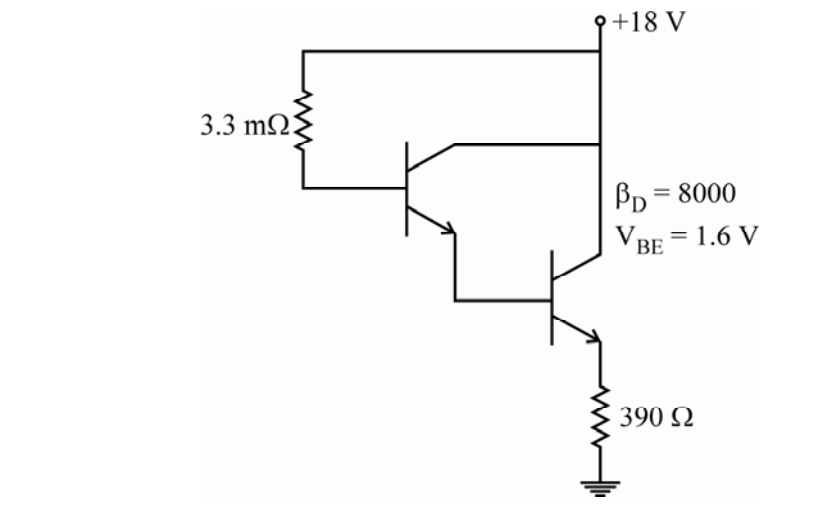
Given
Darlington pair:
$\beta_D=8000$
$V_{BE}=1.6\ \text{V}$
Supply voltage:
$V_{CC}=18\ \text{V}$
Base resistor:
$R_B=3.3\ \text{M}\Omega$
Emitter resistor:
$R_E=390\ \Omega$
Let base current be $I_B$.
Step 1 : Find emitter current
For Darlington pair,
$V_E=V_B-V_{BE}$
and
$V_B=18-I_BR_B$
Hence,
$V_E=18-I_BR_B-1.6$
$=16.4-I_BR_B$
Therefore,
$I_E=\dfrac{16.4-I_BR_B}{390}$
Step 2 : Use current gain relation
For Darlington transistor,
$I_E=(\beta_D+1)I_B$
$=(8000+1)I_B$
$=8001I_B$
Thus,
$8001I_B=\dfrac{16.4-3.3\times10^6 I_B}{390}$
Step 3 : Solve for $I_B$
$390(8001)I_B=16.4-3.3\times10^6 I_B$
$3.12039\times10^6 I_B=16.4-3.3\times10^6 I_B$
$6.42039\times10^6 I_B=16.4$
$I_B=\dfrac{16.4}{6.42039\times10^6}$
$I_B\approx2.55\times10^{-6}\ \text{A}$
Final Answer
$\boxed{I_B\approx2.55\ \mu\text{A}}$
Important Questions from Bipolar Junction Transistors
For a common emitter connection of BJT, find the value of β if α = 0.995
- Which represents the Transport Factor of BJT?
For a bipolar junction transistor in common emitter mode, IC = maximum and VC (collector voltage) = VE (emitter voltage), the transistor operates in _____ mode.
High frequency transistors are designed especially for:
- For an ideal transistor, the reverse parameters (h o& h r) are


