
The given question involves understanding the concepts of synonymous and non-synonymous substitution in evolutionary biology and interpreting what it means if the rate of one exceeds the other. Let's break it down:
- Understanding Synonymous and Non-Synonymous Substitutions:
- Synonymous Substitution: This is a change in the DNA sequence that does not alter the amino acid sequence of a protein. Thus, it is often considered neutral in terms of selection.
- Non-Synonymous Substitution: This is a change in the DNA sequence that results in a change in the amino acid sequence of a protein. Such changes can affect the function of a protein and are subject to selective pressures.
- Analyzing the Rates:
- If the rate of non-synonymous substitution exceeds that of synonymous substitution, it suggests that changes in the protein sequence are advantageous and being favored by natural selection.
- In typical scenarios, synonymous substitutions occur more frequently because they are usually neutral. Non-synonymous substitutions being more frequent indicate positive selection pressure.
- Evaluating Options:
- Deleterious mutations are accumulating: This is unlikely because deleterious mutations tend to decrease fitness and are not positively selected for.
- Evolution is not occurring: This is incorrect because substitution rates being non-neutral indicate ongoing evolution.
- Genetic drift is operating: Genetic drift is a random process, whereas the scenario described involves selection, which is not random.
- Selection is operating: This is correct, as the excess of non-synonymous substitutions suggests positive selection for advantageous traits. Hence, this is the correct answer.
In conclusion, when the rate of non-synonymous substitution at a locus exceeds that of synonymous substitution, it indicates that selection is operating.
Important Questions from Natural selection
- Which one or more of the following is/are NOT essential for evolution by natural selection to take place in a population?
- Two bacterial variants are growing together in the same flask. At any relative frequency of the two variants, the population growth rate of the rarer variant is higher. The above is an example of ________.
There are two species, X and Y, with abundances $x$ and $y$, respectively. Species X has growth rate $\alpha$, and species Y has growth rate $\beta$. Assume that the sum of the species abundances is constant over time, i.e., $x + y = 1$. Let $x$ and $y$ follow the rate equations:
$$\frac{dx}{dt} = \alpha x - \varphi x,$$
$$\frac{dy}{dt} = \beta y - \varphi y,$$ where $\varphi$ is the average species fitness.
Which one of the following options correctly represents the expression for $\varphi$?The figure illustrates the soil zinc tolerance of the grass species Anthoxanthum along a transect from inside a mine to the middle of a pasture outside the mine.
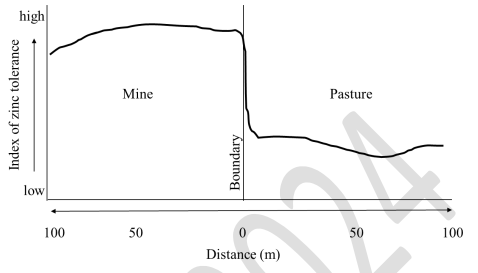
Which one or more of the following processes explain(s) the observed pattern of zinc tolerance in this grass species?From an original population \(P\) of a butterfly species, two experimental populations \(X\) and \(Y\) were established. In \(X\), males and females were maintained in standard conditions, and females were allowed to mate and lay eggs. Only eggs from females laying small clutches (i.e., \(S\) eggs or fewer) were allowed to hatch and the rest were not utilized. In \(Y\), males and females were maintained in standard conditions and females were allowed to mate and lay eggs. From each female, \(S\) eggs were randomly selected and allowed to hatch, and the rest were not utilized. After 20 generations of these experimental conditions, relative to the original population \(P\), and assuming that clutch size is under genetic control, we expect clutch size to be ______________________in \(X\) and ___________________ in \(Y\).


