
If the external force acting on a body is zero then its linear momentum
remains constant
Understanding Linear Momentum Conservation
This question asks about the behavior of a body's linear momentum when there is no external force acting upon it. This scenario directly relates to one of the most important principles in physics: the Law of Conservation of Linear Momentum.
What is Linear Momentum?
Linear momentum is a fundamental concept in physics that describes an object's state of motion. It is defined as the product of an object's mass and its velocity. If an object has mass $m$ and velocity $ \vec{v} $, its linear momentum $ \vec{p} $ is given by the formula:
$ \vec{p} = m \vec{v} $
Momentum is a vector quantity, meaning it has both magnitude and direction, which is the same as the direction of the velocity.
Newton's Second Law and Force
Newton's Second Law of Motion provides a direct link between force and momentum. It states that the net force acting on an object is equal to the rate of change of its linear momentum over time. This can be written as:
$ \vec{F}_{ext} = \frac{d\vec{p}}{dt} $
In this equation, $ \vec{F}_{ext} $ represents the net external force acting on the object, and $ \frac{d\vec{p}}{dt} $ represents the rate at which the linear momentum ($ \vec{p} $) changes with respect to time ($t$).
The Impact of Zero External Force
The question specifies a critical condition: the external force acting on the body is zero. Mathematically, this means:
$ \vec{F}_{ext} = 0 $
By substituting this condition into Newton's Second Law equation, we get:
$ 0 = \frac{d\vec{p}}{dt} $
This equation tells us that the rate of change of the body's linear momentum is zero. When the rate of change of a quantity is zero, it implies that the quantity itself does not change over time. In other words, the linear momentum remains constant.
Conclusion on Momentum
Therefore, if the external force acting on a body is zero, its linear momentum remains constant. This is the essence of the Law of Conservation of Linear Momentum.
Evaluating the Options
Let's examine why the other options are incorrect based on this principle:
- Zero: Linear momentum is zero only if the object is at rest ($ \vec{v}=0 $) or has zero mass. A zero external force does not guarantee that the object is at rest; it could be moving with a constant velocity.
- Decreases: For momentum to decrease, there must be a net external force acting in the direction opposite to the momentum ($ \frac{d\vec{p}}{dt} < 0 $).
- Increases: For momentum to increase, there must be a net external force acting in the same direction as the momentum ($ \frac{d\vec{p}}{dt} > 0 $).
- Remains constant: This is consistent with Newton's Second Law when $ \vec{F}_{ext} = 0 $. The linear momentum does not change its value or direction.
The principle of conservation of linear momentum is applicable to systems as well as individual bodies, provided there are no net external forces acting on the system.
Important Questions from Laws of Motion
Which one of the following is an example of Second Class Lever?
A uniform meter scale of mass 0.24 kg is made of steel. It is kept on two wedges, W1 and W2 , in a horizontal position. W1 is at a distance of 0.2 m from one of its ends, while W2 is at distance of 0.4 m from the other end. If the force on the scale is N1 due to W1 and N2 due to W2, then : (take g =10·0 m s-2
Consider a journey by a car represented by the graph given below in three parts A, B and C. The speed of the car in these parts is Va, Vb and Vc, respectively:
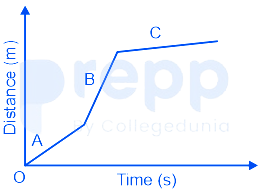
Which one of the following is correct in this case?
Rocket works on the principle of:
A rocket is launched to travel vertically upward with a constant velocity of 20 m/s. After travelling for 35 seconds, the rocket develops a snag and its fuel supply is cut off. The rocket then travels like a free body. The height achieved by it is:


