
If A × B means A is to be south of B; A + B means A is to the north of B; A% B means A is to the east of B; A – B means A is to the west of B: then in P% Q + R – S, S is in which direction with respect to Q?
Understanding Directional Relationships in Reasoning Problems
This question involves decoding symbolic relationships to determine the relative positions of different points. We are given a set of rules where symbols represent specific directions. We need to apply these rules to a given expression to find the direction of one point with respect to another.
Decoding the Symbols
Let's first understand what each symbol signifies based on the problem description:
- A × B means A is to the south of B.
- A + B means A is to the north of B.
- A % B means A is to the east of B.
- A – B means A is to the west of B.
We are given the expression: P% Q + R – S
Let's break this expression down into individual relationships:
- P% Q: According to the rules, A % B means A is to the east of B. So, P is to the east of Q. (This part is not needed to find the relation between S and Q, but it helps break down the expression).
- Q + R: According to the rules, A + B means A is to the north of B. So, Q is to the north of R. This also implies that R is to the south of Q.
- R – S: According to the rules, A – B means A is to the west of B. So, R is to the west of S. This also implies that S is to the east of R.
Determining the Direction of S with Respect to Q
We need to find the direction of S with respect to Q. From our analysis:
- From relationship 2 (Q + R), we know that R is to the south of Q.
- From relationship 3 (R – S), we know that S is to the east of R.
Let's visualize or think about the positions:
- Start at Q.
- Move south from Q to reach R.
- From R, move east to reach S.
If you move south and then east from a point, your final position will be in the South-east direction relative to the starting point.
Therefore, S is in the South-east direction with respect to Q.
Step-by-Step Analysis
Let's trace the path from Q to S:
- Locate Q.
- The relation Q + R tells us Q is north of R. This means R is located directly south of Q.
- The relation R – S tells us R is west of S. This means S is located directly east of R.
- Starting from Q, if we go south to R, and then east from R to S, the position of S relative to Q is south-east.
Consider a coordinate system for clarity (assuming Q is at origin (0,0)):
- R is South of Q, so R could be at (0, -y) where y > 0.
- S is East of R, so S could be at (x, -y) where x > 0.
A point with a positive x-coordinate and a negative y-coordinate is in the fourth quadrant, which corresponds to the South-east direction.
Conclusion
Based on the given directional rules and the expression P% Q + R – S, S is located in the South-east direction with respect to Q.
| Expression Part | Relationship | Implication for S & Q |
|---|---|---|
| P% Q | P East of Q | Not directly relevant for S w.r.t Q |
| Q + R | Q North of R | R is South of Q |
| R – S | R West of S | S is East of R |
Revision Table: Directional Symbols
| Symbol | Meaning (A w.r.t B) |
|---|---|
| × | South |
| + | North |
| % | East |
| – | West |
Additional Information: Spatial Reasoning Tips
Spatial reasoning questions often involve understanding and manipulating the relative positions of objects or points. Here are some tips for solving such problems:
- Draw a Diagram: For complex relationships, drawing a simple diagram can be very helpful. Represent points and draw arrows indicating the direction.
- Break Down the Problem: Analyze each part of the given expression or statement separately.
- Establish a Reference Point: Identify the point with respect to which you need to determine the direction. In this question, it is Q.
- Combine Relationships: Link the individual relationships together logically to trace the position of the final point from the reference point.
- Understand Compound Directions: Know how cardinal directions (North, South, East, West) combine to form intermediate directions (North-east, South-east, South-west, North-west). Moving South then East results in South-east. Moving North then West results in North-west, and so on.
Practicing different types of spatial reasoning questions will improve your ability to quickly decode symbols and visualize relative positions.
Important Questions from Coded direction and Distance
Refer to the following number, symbol series and answer the question. Counting to be done from left to right only.
(Left) #1 * £ 3 & @ $ 8 $ 7 + 5 4 2 0 2 9 % (Right)
How many such symbols are there each of which is immediately preceded by a number and also immediately followed by another symbol?
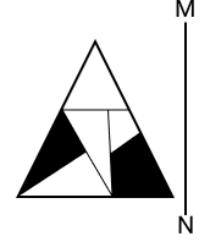
Select the correct mirror image of the given figure when the mirror is placed at MN as shown below.
AT 9 pm, the hour hand faces north, Which direction will the minute hand face at 6.30 am?
Latika and her friend are seated at a restaurant facing each other. Latika is facing west. The waiter comes to take the order and stands at 90° to the right of Latika. In which direction is the waiter facing?
- City A is located to the North of city B. City D is located to the East of city B. City C is located to the West of city D. City É is located to the South of city C and to the South- West of city A. What is the position of city B with respect to city C?


