
How many nodes and junctions are present respectively in the circuit shown below?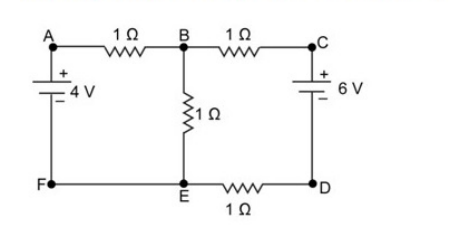
To determine the number of nodes and junctions in the circuit, let's first clarify the definitions:
- Node: A point where two or more circuit elements meet.
- Junction: A point where three or more circuit elements meet.
Now, let's analyze the given circuit diagram:
Identify the nodes in the circuit:
- Node A: Battery and resistor meet.
- Node B: Three resistors meet.
- Node C: Resistor and battery meet.
- Node D: Resistor connects.
- Node E: Three resistors meet.
- Node F: Battery and resistor meet.
Based on the above, the nodes are A, B, C, D, E, and F. However, A, C, D, and F connect to two elements each while B and E connect to three.
Identify the junctions in the circuit:
- Junction B: Where three resistors converge.
- Junction E: Where three resistors converge.
Based on the definition of junctions, we identify that junctions are present at B and E.
Therefore, there are a total of 6 nodes and 2 junctions.
Conclusion: The correct number of nodes and junctions in the circuit are 5 nodes (consider nodes A, B, C, E, F for simplicity, usually junctions considered as nodes in circuit analysis) and 2 junctions.
The correct answer is 5, 2.
Important Questions from Circuit Elements
A color code of orange, orange, orange is for what ohmic value?
In wire-wound standard resistor, the bifilar winding is adopted to reduce ______.
Change in resistance of a conductor on increasing its length 3 times will be
The voltage induced in an inductor is represented as
Which component opposes voltage change?


