
Figure shows a coil C connected to a galvanometer G. When the North-pole of a bar magnet is pushed towards the coil, the pointer in the galvanometer deflects. Regarding this set up, the following statements are given: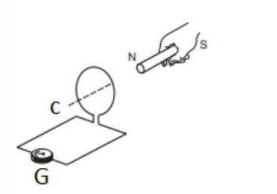
(A) It indicates the presence of electric current in the coil.
(B) The deflection is found to be smaller when the magnet is pushed towards the coil faster.
(C) There is repulsion in the moving magnet and the magnetic pole induced in the coil facing towards the N pole of the magnet.
(D) If the bar magnet does not move, there is no induced current in the coil.
Choose the correct answer from the options given below:
To solve this question, we need to understand the principles of electromagnetic induction as described by Faraday's Law.
-
Statement (A): "It indicates the presence of electric current in the coil."
This statement is true. According to Faraday’s Law, when the magnet is moved towards the coil, it induces an electromotive force (EMF) in the coil, resulting in a current, which is detected as a deflection in the galvanometer.
-
Statement (B): "The deflection is found to be smaller when the magnet is pushed towards the coil faster."
This statement is false. A faster change in the magnetic field (faster movement of the magnet) induces a greater EMF, resulting in greater deflection, not smaller.
-
Statement (C): "There is repulsion in the moving magnet and the magnetic pole induced in the coil facing towards the N pole of the magnet."
This statement is true. Lenz’s Law states that the direction of induced current is such that it opposes the change in magnetic field, causing a repulsive interaction.
-
Statement (D): "If the bar magnet does not move, there is no induced current in the coil."
This statement is true. No movement implies no change in magnetic flux, so no EMF or current is induced.
The correct answer is therefore the option including statements (A), (C), and (D) only.
Important Questions from Electromagnetic Induction
In a pair of adjacent coils, for a change of current in one of the coils from 0 A to 10 A in 0.25 s, the magnetic flux in the adjacent coil changes by 15 Wb. The mutual inductance of the coils is:
A 50 Hz AC current of crest value 1 A flows through the primary of a transformer. If the mutual inductance between the primary and secondary is 0.5 H, the crest voltage induced in the secondary is:
A long solenoid of diameter 0.1 m has 2 × 10⁴ turns per meter. At the center of the solenoid, a coil of 100 turns and radius 0.01 m is placed with its axis coinciding with the solenoid axis. The current in the solenoid reduces at a constant rate to 0 A from 4 A in 0.05 s. If the resistance of the coil is 10π² Ω, then the total charge flowing through the coil during this time is:
Lower half of a convex lens is made opaque. Which of the following statements describes the image of the object placed in front of the lens?
A transformer has an efficiency of 80%. It works at 3 kW and 120 V. If the secondary voltage is 240 V, what will be the secondary current?


