
To evaluate the expression $(-9) - (-56) ÷ (-14) + (-4) × 7$, we follow the order of operations (BODMAS/PEMDAS): Brackets/Parentheses, Orders/Exponents, Division and Multiplication (from left to right), Addition and Subtraction (from left to right).
Evaluating the Expression Step-by-Step
-
Division: First, calculate the division part: $(-56) ÷ (-14)$.
A negative number divided by a negative number results in a positive number.
$ \frac{-56}{-14} = 4 $
-
Multiplication: Next, calculate the multiplication part: $(-4) × 7$.
A negative number multiplied by a positive number results in a negative number.
$ (-4) \times 7 = -28 $
-
Substitute and Subtract: Substitute the results back into the expression and perform subtraction.
The expression becomes: $(-9) - 4 + (-28)$.
Subtract 4 from -9:
$ -9 - 4 = -13 $
-
Add: Finally, perform the addition.
The expression is now: $-13 + (-28)$.
Adding a negative number is the same as subtracting the positive number:
$ -13 + (-28) = -13 - 28 = -41 $
Therefore, the value of the expression $(-9) - (-56) ÷ (-14) + (-4) × 7$ is -41.
Important Questions from Simplification (Notes)
- $\frac{\sqrt[3]{6859}}{\sqrt[4]{256}} \times \frac{2}{57} \times 168 = ?$
- In the Delhi zoo, there are some ducks and rabbits. If the heads are counted there are 160, while the legs are 450. What will be number of ducks in the zoo ?
Identify the number that will replace the question mark in the second equation based on the relationship represented in the first equation.
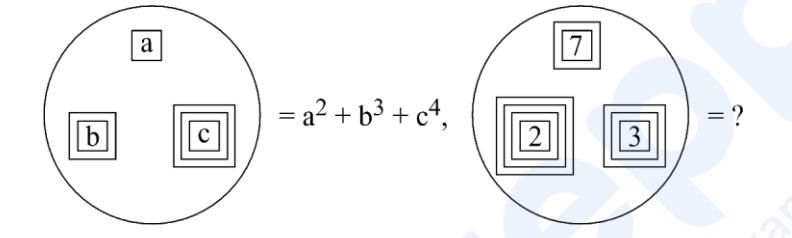
- Simplify $(5z-12y)^2 + (12z+5y)^2 - 144z^2$.
- Simplify: $[(36 + 4 \times (3 + 2 \times (5 - 2))) \div (6 + 3)] + [(40 - (6 + 3 \times 2)) + (8 \times 2 - 6)]$


