
Deflection of beams in pre-stressed concrete structures w.r.t. RCC structures is:
Less
Deflection in Pre-stressed Concrete vs. RCC Beams
When comparing the deflection of beams in pre-stressed concrete structures with those in reinforced concrete (RCC) structures, it is generally observed that pre-stressed concrete beams exhibit less deflection. This difference is a fundamental advantage of pre-stressing in structural design.
Pre-stressed Concrete Beams and Deflection Control
Pre-stressed concrete is a specialized type of concrete where internal compressive stresses are intentionally introduced into the concrete members during fabrication. This is achieved by tensioning high-strength steel tendons (wires, strands, or bars) and then anchoring them, thereby transferring the pre-stressing force to the concrete. The primary goal of this pre-stress is to counteract the tensile stresses that would otherwise develop in the concrete due to external service loads (like dead and live loads). Concrete is inherently very strong in compression but weak in tension.
- Counteracting External Loads: The pre-stressing force creates an initial upward camber or hogging in the beam. When external downward loads are applied, the downward deflection caused by these loads is effectively offset by this initial upward deflection from pre-stressing, resulting in a significantly reduced net downward deflection.
- Enhanced Crack Resistance: The sustained compressive force from pre-stressing ensures that the concrete remains uncracked or only minimally cracked under normal service loads. In reinforced concrete (RCC) structures, concrete often cracks in the tension zone at relatively low loads. Since uncracked concrete contributes significantly to stiffness, maintaining an uncracked section in pre-stressed concrete beams leads to higher overall stiffness.
- Increased Stiffness: Because a larger effective concrete section remains active and uncracked under load, pre-stressed concrete beams possess greater effective stiffness compared to RCC beams of similar dimensions. Higher stiffness directly translates to smaller deflections under the same loading conditions, which is crucial for the serviceability of a structure.
Reinforced Concrete (RCC) Beams and Deflection
Reinforced concrete (RCC) structures rely on steel reinforcement bars to resist tensile forces, as concrete itself is brittle in tension. In an RCC beam, when bending loads are applied, the concrete in the tension zone inevitably cracks. Once cracking occurs, the steel reinforcement primarily carries the tensile forces.
- Effect of Cracking: The cracking of concrete in the tension zone of an RCC beam leads to a reduction in the effective moment of inertia of the beam's cross-section. This reduction in stiffness, often referred to as cracked moment of inertia, results in larger deflections compared to an uncracked section.
- Serviceability Concerns: For larger spans or where strict deflection limits are required (e.g., to prevent damage to non-structural elements or for aesthetic reasons), the inherent deflection in RCC structures can become a limiting factor.
Comparison of Deflection Performance
In summary, the internal pre-compression in pre-stressed concrete beams effectively minimizes tensile stresses, keeps the concrete uncracked, and thus maintains a higher effective stiffness. This leads to significantly less deflection under service loads. Conversely, RCC beams experience cracking in the tension zone, which reduces their stiffness and results in greater deflections for similar span and loading conditions.
| Feature | Pre-stressed Concrete Beams | Reinforced Concrete (RCC) Beams |
|---|---|---|
| Initial Stress State | Built-in compressive forces (pre-stress) | No initial internal forces (stressed only by external loads) |
| Tensile Zone Behavior | Largely uncracked or minimally cracked under service loads due to pre-compression. | Concrete cracks in the tension zone; steel bars resist tension. |
| Effective Stiffness | Higher (larger effective uncracked section) | Lower (reduced due to cracking and reliance on steel) |
| Deflection under Service Load | Less | More |
| Typical Application | Longer spans, heavy loads, bridges, where deflection control is critical. | Shorter to medium spans, general building construction. |
Therefore, the deflection of beams in pre-stressed concrete structures is less compared to reinforced concrete (RCC) structures.
Important Questions from Analysis of Prestress
An inverted T-shaped concrete beam (B1) in the figure, with centroidal axis X - X, is subjected to an effective prestressing force of 1000 kN acting at the bottom kern point of the beam cross-section. Also consider an identical concrete beam (B2) with the same grade of concrete but without any prestressing force.
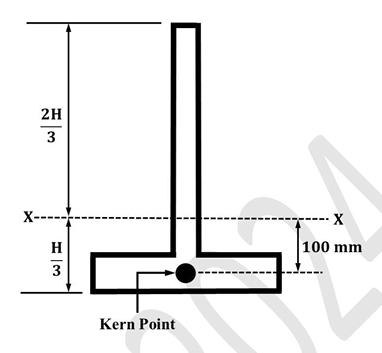
The additional cracking moment (in kN.m) that can be carried by beam B1 in comparison to beam B2 is ____________ (rounded off to the nearest integer).
- As per India standard code of practice for prestressed concrete (IS:1343-1980) the minimum grades of concrete to be used for post-tensioned and pre-tensioned structural elements are respectively
A method of prestressing concrete by tensioning the tendons against hardened concrete is known as:
In pre-stressed concrete, high-grade concrete is used for -
As per IS:1343-2012, the minimum characteristic strength of pre-stressed concrete to be used for post-tensioned and pre-tensioned structural elements are respectively:


