
An inverted T-shaped concrete beam (B1) in the figure, with centroidal axis X - X, is subjected to an effective prestressing force of 1000 kN acting at the bottom kern point of the beam cross-section. Also consider an identical concrete beam (B2) with the same grade of concrete but without any prestressing force. The additional cracking moment (in kN.m) that can be carried by beam B1 in comparison to beam B2 is ____________ (rounded off to the nearest integer).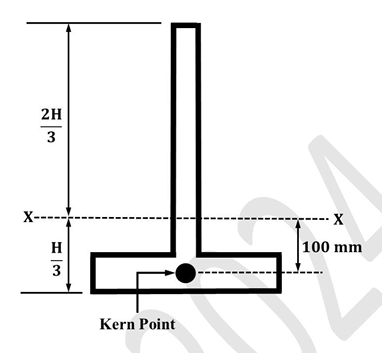
For a prestressed concrete section, the additional cracking moment gained due to prestressing is:
\( M_{\text{add}} = P \times e_k \)
where:
\( P = 1000 \, \text{kN} \) (effective prestressing force)
\( e_k \) = distance of the kern point from the centroidal axis
From the given inverted T-section geometry, the bottom kern point lies at:
\( e_k = \dfrac{H}{3} = 0.3 \, \text{m} \)
Therefore, the additional cracking moment carried by beam B1 is:
\( M_{\text{add}} = 1000 \times 0.3 = 300 \, \text{kN·m} \)
Beam B2 has no prestressing force, hence no additional cracking moment.
\( \boxed{300 \, \text{kN·m}} \)
Important Questions from Analysis of Prestress
In pre-stressed concrete, high-grade concrete is used for -
Which of the following pre-stressing systems employs high tensile bars with thread at ends?
For prestressed concrete, which code is to be used?
Determine the eccentricity of a load balancing cable for a beam of size 350 × 750 mm at centre of it. The beam subjected to a live load of 10 KN/m over a span of 9 m and is simply supported. The prestressing force applied is 1700 KN.
As per IS:1343-2012, the minimum characteristic strength of pre-stressed concrete to be used for post-tensioned and pre-tensioned structural elements are respectively:


