
Consider two infinitely large plane parallel conducting plates as shown below. The plates are uniformly charged with a surface charge density $+ \sigma$ and $- 2\sigma$. The force experienced by a point charge $+ q$ placed at the mid point between two plates will be :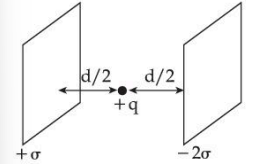
The problem involves two infinitely large plane parallel conducting plates, one with a surface charge density of \(+ \sigma\) and the other with \(-2\sigma\). A point charge \(+ q\) is located at the midpoint between these plates.
Understanding Electric Field Between Plates
The electric field due to an infinite plane with surface charge density \(\sigma\) is given by:
\(E = \frac{\sigma}{2\epsilon_0}\)
where \(\epsilon_0\) is the permittivity of free space.
- Electric field \(E_1\) due to the plate with charge \(+\sigma\) is directed away from the plate and given by: \(E_1 = \frac{\sigma}{2\epsilon_0}\).
- Electric field \(E_2\) due to the plate with charge \(-2\sigma\) is directed towards the plate and is given by: \(E_2 = \frac{2\sigma}{2\epsilon_0} = \frac{\sigma}{\epsilon_0}\).
Since these fields are in opposite directions, the net electric field \(E_{\text{net}}\) between the plates at the position of the charge \(+ q\) is:
\(E_{\text{net}} = E_2 - E_1 = \frac{\sigma}{\epsilon_0} - \frac{\sigma}{2\epsilon_0} = \frac{\sigma}{2\epsilon_0}\) (directed towards the plate with \(-2\sigma\)).
Force on the Point Charge
The force \(F\) experienced by the point charge \(+ q\) in an electric field \(E_{\text{net}}\) is given by:
\(F = q \cdot E_{\text{net}}\)
Substituting the value of \(E_{\text{net}}\) we get:
\(F = q \cdot \frac{\sigma}{2\epsilon_0} = \frac{\sigma q}{2\epsilon_0}\)
Conclusion
The force experienced by the point charge \(+ q\) is \(\frac{3\sigma q}{2\epsilon_0}\), as it experiences an additional interaction due to the superposition principle when considering both fields created by the two plates.
Image:
Similar Questions
Two blocks of masses $m$ and $M$, ($M > m$), are placed on a frictionless table as shown in figure. A massless spring with spring constant $k$ is attached with the lower block. If the system is slightly displaced and released, then
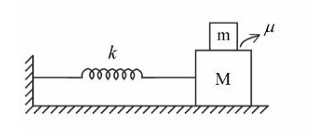
A. The time period of small oscillation of the two blocks is $T = 2\pi \sqrt{\frac{(m+M)}{k}}$
B. The acceleration of the blocks is $a = \frac{kx}{M+m}$ (x = displacement of the blocks from the mean position)
C. The magnitude of the frictional force on the upper block is $\frac{\mu m|x|}{M+m}$
D. The maximum amplitude of the upper block, if it does not slip, is $\frac{\mu (M+m)g}{k}$
E. Maximum frictional force can be $\mu(M + m) g$.
Choose the correct answer from the options given below:
A wire of length $25 \ m$ and cross-sectional area $5 \ mm^2$ having resistivity of $2 \times 10^{-6} \ \Omega \ m$ is bent into a complete circle. The resistance between diametrically opposite points will be
(DROPPED)
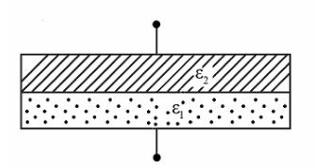
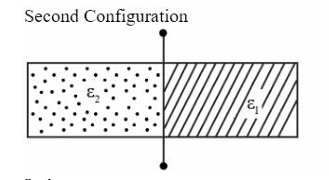
A parallel plate capacitor is filled equally(half) with two dielectrics of dielectric constants $\varepsilon_1$ and $\varepsilon_2$, as shown in figures. The distance between the plates is $d$ and area of each plate is $A$. If capacitance in first configuration and second configuration are $C_1$ and $C_2$ respectively, then $\frac{C_1}{C_2}$ is :
First Configuration
The electrostatic potential on the surface of uniformly charged spherical shell of radius $R = 10 \ cm$ is $120 \ V$. The potential at the centre of shell, at a distance $r = 5 \ cm$ from centre, and at a distance $r = 15 \ cm$ from the centre of the shell respectively, are:
The radiation pressure exerted by a $450 \ W$ light source on a perfectly reflecting surface placed at $2m$ away from it, is
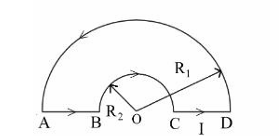
A loop ABCDA, carrying current I = 12 A, is placed in a plane, consists of two semi-circular segments of radius $R_1 = 6\pi$ m and $R_2 = 4\pi$ m. The magnitude of the resultant magnetic field at center O is $k\times10^{-7}$ T. The value of k is __________
(Given $\mu_0 = 4\pi \times 10^{-7}$ Tm $A^{-1}$)
A small bob of mass 100 mg and charge $+10 \text{ }\mu C$ is connected to an insulating string of length 1 m. It is brought near to an infinitely long non-conducting sheet of charge density '$\sigma$' as shown in figure. If string subtends an angle of $45^\circ$ with the sheet at equilibrium the charge density of sheet will be.
(Given, $\epsilon_0 = 8.85\times10^{-12} \frac{F}{m}$ and acceleration due to gravity, $g=10 \frac{m}{s^2}$)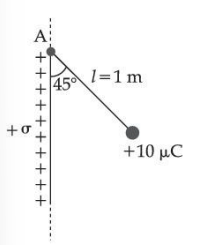
- The battery of a mobile phone is rated as 4.2 V, 5800 mAh. How much energy is stored in it when fully charged ?
The relationship between the magnetic susceptibility ($\chi$) and the magnetic permeability ($\mu$) is given by :
($\mu_0$ is the permeability of free space and $\mu_r$ is relative permeability)- Let $B_1$ be the magnitude of magnetic field at center of a circular coil of radius $R$ carrying current $I$. Let $B_2$ be the magnitude of magnetic field at an axial distance '$x$' from the center. For $x:R=3:4$, $\frac{B_2}{B_1}$ is:
Important Questions from Electricity and Magnetism
Two blocks of masses $m$ and $M$, ($M > m$), are placed on a frictionless table as shown in figure. A massless spring with spring constant $k$ is attached with the lower block. If the system is slightly displaced and released, then
A. The time period of small oscillation of the two blocks is $T = 2\pi \sqrt{\frac{(m+M)}{k}}$
B. The acceleration of the blocks is $a = \frac{kx}{M+m}$ (x = displacement of the blocks from the mean position)
C. The magnitude of the frictional force on the upper block is $\frac{\mu m|x|}{M+m}$
D. The maximum amplitude of the upper block, if it does not slip, is $\frac{\mu (M+m)g}{k}$
E. Maximum frictional force can be $\mu(M + m) g$.
Choose the correct answer from the options given below:
A wire of length $25 \ m$ and cross-sectional area $5 \ mm^2$ having resistivity of $2 \times 10^{-6} \ \Omega \ m$ is bent into a complete circle. The resistance between diametrically opposite points will be
(DROPPED)
A parallel plate capacitor is filled equally(half) with two dielectrics of dielectric constants $\varepsilon_1$ and $\varepsilon_2$, as shown in figures. The distance between the plates is $d$ and area of each plate is $A$. If capacitance in first configuration and second configuration are $C_1$ and $C_2$ respectively, then $\frac{C_1}{C_2}$ is :
First Configuration
The electrostatic potential on the surface of uniformly charged spherical shell of radius $R = 10 \ cm$ is $120 \ V$. The potential at the centre of shell, at a distance $r = 5 \ cm$ from centre, and at a distance $r = 15 \ cm$ from the centre of the shell respectively, are:
The radiation pressure exerted by a $450 \ W$ light source on a perfectly reflecting surface placed at $2m$ away from it, is


