
A parallel plate capacitor is filled equally(half) with two dielectrics of dielectric constants $\varepsilon_1$ and $\varepsilon_2$, as shown in figures. The distance between the plates is $d$ and area of each plate is $A$. If capacitance in first configuration and second configuration are $C_1$ and $C_2$ respectively, then $\frac{C_1}{C_2}$ is : First Configuration 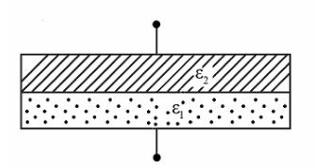
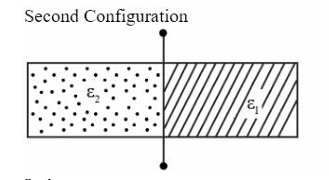
$\frac{4\varepsilon_1\varepsilon_2}{(\varepsilon_1+\varepsilon_2)^2}$
To solve the problem, we need to find the ratio of capacitances in two configurations: the first configuration with the dielectrics stacked vertically and the second configuration with the dielectrics placed side by side.
Configuration Analysis
First Configuration
In the first configuration, the capacitor is filled with dielectrics of constants \(\varepsilon_1\) and \(\varepsilon_2\) separated vertically, forming two capacitors in series.
The capacitance for a series arrangement is given by:
\[\frac{1}{C_1} = \frac{1}{C_{1_1}} + \frac{1}{C_{1_2}}\]Where:
- \(C_{1_1} = \frac{\varepsilon_1 \varepsilon_0 A}{2d}\) for the section with dielectric \(\varepsilon_1\)
- \(C_{1_2} = \frac{\varepsilon_2 \varepsilon_0 A}{2d}\) for the section with dielectric \(\varepsilon_2\)
Combining these, we get:
\[\frac{1}{C_1} = \frac{2d}{\varepsilon_1 \varepsilon_0 A} + \frac{2d}{\varepsilon_2 \varepsilon_0 A}\]\[C_1 = \frac{\varepsilon_1 \varepsilon_2 \varepsilon_0 A}{d(\varepsilon_1 + \varepsilon_2)}\]Second Configuration
In the second configuration, the capacitor consists of two capacitors in parallel.
The capacitance for a parallel arrangement is given by:
\[C_2 = C_{2_1} + C_{2_2}\]Where:
- \(C_{2_1} = \frac{\varepsilon_1 \varepsilon_0 \left(\frac{A}{2}\right)}{d}\)
- \(C_{2_2} = \frac{\varepsilon_2 \varepsilon_0 \left(\frac{A}{2}\right)}{d}\)
Ratio of Capacitances
The ratio of the capacitances is:
\[\frac{C_1}{C_2} = \frac{\frac{\varepsilon_1 \varepsilon_2 \varepsilon_0 A}{d(\varepsilon_1 + \varepsilon_2)}}{\frac{\varepsilon_0 A}{2d}(\varepsilon_1 + \varepsilon_2)}\]\[\frac{C_1}{C_2} = \frac{2\varepsilon_1 \varepsilon_2}{(\varepsilon_1 + \varepsilon_2)^2} \] \]\]The given correct answer matches this result:
\(\frac{4\varepsilon_1\varepsilon_2}{(\varepsilon_1+\varepsilon_2)^2}\)
Similar Questions
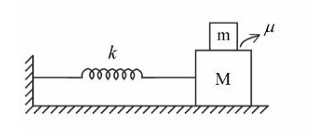
Two blocks of masses $m$ and $M$, ($M > m$), are placed on a frictionless table as shown in figure. A massless spring with spring constant $k$ is attached with the lower block. If the system is slightly displaced and released, then
A. The time period of small oscillation of the two blocks is $T = 2\pi \sqrt{\frac{(m+M)}{k}}$
B. The acceleration of the blocks is $a = \frac{kx}{M+m}$ (x = displacement of the blocks from the mean position)
C. The magnitude of the frictional force on the upper block is $\frac{\mu m|x|}{M+m}$
D. The maximum amplitude of the upper block, if it does not slip, is $\frac{\mu (M+m)g}{k}$
E. Maximum frictional force can be $\mu(M + m) g$.
Choose the correct answer from the options given below:
A wire of length $25 \ m$ and cross-sectional area $5 \ mm^2$ having resistivity of $2 \times 10^{-6} \ \Omega \ m$ is bent into a complete circle. The resistance between diametrically opposite points will be
(DROPPED)
The electrostatic potential on the surface of uniformly charged spherical shell of radius $R = 10 \ cm$ is $120 \ V$. The potential at the centre of shell, at a distance $r = 5 \ cm$ from centre, and at a distance $r = 15 \ cm$ from the centre of the shell respectively, are:
The radiation pressure exerted by a $450 \ W$ light source on a perfectly reflecting surface placed at $2m$ away from it, is
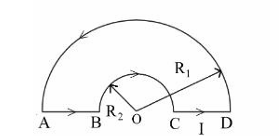
A loop ABCDA, carrying current I = 12 A, is placed in a plane, consists of two semi-circular segments of radius $R_1 = 6\pi$ m and $R_2 = 4\pi$ m. The magnitude of the resultant magnetic field at center O is $k\times10^{-7}$ T. The value of k is __________
(Given $\mu_0 = 4\pi \times 10^{-7}$ Tm $A^{-1}$)
A small bob of mass 100 mg and charge $+10 \text{ }\mu C$ is connected to an insulating string of length 1 m. It is brought near to an infinitely long non-conducting sheet of charge density '$\sigma$' as shown in figure. If string subtends an angle of $45^\circ$ with the sheet at equilibrium the charge density of sheet will be.
(Given, $\epsilon_0 = 8.85\times10^{-12} \frac{F}{m}$ and acceleration due to gravity, $g=10 \frac{m}{s^2}$)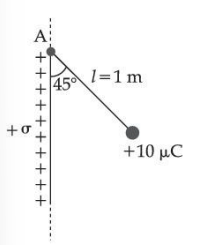
- The battery of a mobile phone is rated as 4.2 V, 5800 mAh. How much energy is stored in it when fully charged ?
The relationship between the magnetic susceptibility ($\chi$) and the magnetic permeability ($\mu$) is given by :
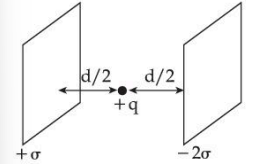
($\mu_0$ is the permeability of free space and $\mu_r$ is relative permeability)Consider two infinitely large plane parallel conducting plates as shown below. The plates are uniformly charged with a surface charge density $+ \sigma$ and $- 2\sigma$. The force experienced by a point charge $+ q$ placed at the mid point between two plates will be :
- Let $B_1$ be the magnitude of magnetic field at center of a circular coil of radius $R$ carrying current $I$. Let $B_2$ be the magnitude of magnetic field at an axial distance '$x$' from the center. For $x:R=3:4$, $\frac{B_2}{B_1}$ is:
Important Questions from Electricity and Magnetism
Two blocks of masses $m$ and $M$, ($M > m$), are placed on a frictionless table as shown in figure. A massless spring with spring constant $k$ is attached with the lower block. If the system is slightly displaced and released, then
A. The time period of small oscillation of the two blocks is $T = 2\pi \sqrt{\frac{(m+M)}{k}}$
B. The acceleration of the blocks is $a = \frac{kx}{M+m}$ (x = displacement of the blocks from the mean position)
C. The magnitude of the frictional force on the upper block is $\frac{\mu m|x|}{M+m}$
D. The maximum amplitude of the upper block, if it does not slip, is $\frac{\mu (M+m)g}{k}$
E. Maximum frictional force can be $\mu(M + m) g$.
Choose the correct answer from the options given below:
A wire of length $25 \ m$ and cross-sectional area $5 \ mm^2$ having resistivity of $2 \times 10^{-6} \ \Omega \ m$ is bent into a complete circle. The resistance between diametrically opposite points will be
(DROPPED)
The electrostatic potential on the surface of uniformly charged spherical shell of radius $R = 10 \ cm$ is $120 \ V$. The potential at the centre of shell, at a distance $r = 5 \ cm$ from centre, and at a distance $r = 15 \ cm$ from the centre of the shell respectively, are:
The radiation pressure exerted by a $450 \ W$ light source on a perfectly reflecting surface placed at $2m$ away from it, is
A loop ABCDA, carrying current I = 12 A, is placed in a plane, consists of two semi-circular segments of radius $R_1 = 6\pi$ m and $R_2 = 4\pi$ m. The magnitude of the resultant magnetic field at center O is $k\times10^{-7}$ T. The value of k is __________
(Given $\mu_0 = 4\pi \times 10^{-7}$ Tm $A^{-1}$)


