
Consider the following statements (all the angles are measured in degrees) :
1. If two supplementary angles are $4x + 40$ and $10x$, then $x$ is;
2. The complementary angle of $\frac{4}{5} \times 45$ is :
3. If two complementary angles are in the ratio of $4 : 5$, then the smallest angle is :
Which of the following is correct?
Codes:
1 2 3
Detailed Solution for Angle Problems MCQ
This solution breaks down each statement in the question to find the values of $x$, the complementary angle, and the smallest angle based on the given conditions.
Statement 1: Solving for $x$ with Supplementary Angles
Two angles are supplementary if their sum is 180 degrees. The given angles are $4x + 40$ and $10x$.
To find $x$, we set up the equation:
$ (4x + 40) + 10x = 180 $
Combine the terms with $x$:
$ 14x + 40 = 180 $
Subtract 40 from both sides:
$ 14x = 180 - 40 $
$ 14x = 140 $
Divide by 14:
$ x = \frac{140}{14} $
$ x = 10 $
So, the value of $x$ is 10.
Statement 2: Finding the Complementary Angle
Two angles are complementary if their sum is 90 degrees. We need to find the complementary angle of $(4/5) * 45$.
First, calculate the value of the given angle:
$ \text{Angle} = \frac{4}{5} \times 45 $
$ \text{Angle} = 4 \times \frac{45}{5} $
$ \text{Angle} = 4 \times 9 $
$ \text{Angle} = 36 \text{ degrees} $
Now, find the complementary angle by subtracting this value from 90 degrees:
$ \text{Complementary Angle} = 90 - 36 $
$ \text{Complementary Angle} = 54 \text{ degrees} $
The complementary angle is 54 degrees.
Statement 3: Calculating the Smallest Angle from a Ratio
Two angles are complementary, meaning they add up to 90 degrees. They are in the ratio of $4 : 5$.
Let the angles be $4y$ and $5y$.
Their sum is 90 degrees:
$ 4y + 5y = 90 $
Combine the terms with $y$:
$ 9y = 90 $
Divide by 9:
$ y = \frac{90}{9} $
$ y = 10 $
The two angles are:
- First angle = $4y$ = $4 * 10$ = 40 degrees
- Second angle = $5y$ = $5 * 10$ = 50 degrees
The smallest angle is 40 degrees.
Conclusion
Based on the calculations for each statement:
- Statement 1 yields $x = 10$.
- Statement 2 yields the complementary angle = 54 degrees.
- Statement 3 yields the smallest angle = 40 degrees.
These values correspond to the sequence 10, 54, 40.
| Statement | Result |
|---|---|
| Value of $x$ (Supplementary Angles) | 10 |
| Complementary Angle | 54 |
| Smallest Angle (Ratio) | 40 |
Comparing these results with the options, option (C) matches the calculated values: 10, 54, 40.
Important Questions from Permutation and Combination
The following figure is made with nine squares of length 1 cm each.
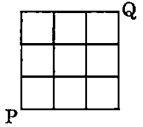
A student is standing at point P. The total number of shortest paths to reach point Q from point P, if the student walks along the boundaries of the squares only, is:
- There are 40 persons in a palace. If every person shakes hands with every other person, what will be the total number of handshakes?
- How many words can be formed with or without meaning by using all letters of the word DELHI?
A rectangular wall is divided into four squares of equal size where there are two rows each having two squares. The top left square is coloured with green. If, including green, there are three colours available and each square is coloured using any one of these three colours such that no two adjacent squares get painted with the same colour; then how many colour combinations are possible ?
How many 3 digit odd numbers can be made from the digits 5, 2, 1, 3, 4 ? (without repetiton)


