
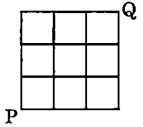
The following figure is made with nine squares of length 1 cm each. A student is standing at point P. The total number of shortest paths to reach point Q from point P, if the student walks along the boundaries of the squares only, is:
Understanding the Grid and Pathfinding
The problem asks us to find the number of shortest paths from a starting point P to an ending point Q. We are given a figure made of nine squares, each with a side length of 1 cm. This forms a larger square grid. The student can only walk along the boundaries of these squares.
Let's visualize the grid. Since there are nine squares arranged in a 3x3 pattern, the total dimensions of the figure are 3 cm by 3 cm. Point P is at the top-left corner, and point Q is at the bottom-right corner of this 3 cm x 3 cm square.
Defining Shortest Paths
For a path to be considered the shortest path on a grid like this, the movement must always progress towards the destination. In this case, from P (top-left) to Q (bottom-right), the student can only move right or down. Moving left or up would increase the path length, making it not a shortest path.
Calculating Required Movements
To get from P to Q, the student needs to cover a total horizontal distance and a total vertical distance:
- Horizontal distance: The grid is 3 cm wide (made of 3 squares side-by-side). So, the student must make 3 moves to the right.
- Vertical distance: The grid is 3 cm tall (made of 3 squares stacked vertically). So, the student must make 3 moves down.
In total, any shortest path will consist of exactly 3 right moves and 3 down moves, making a total of $3 + 3 = 6$ moves.
Applying Combinatorics to Count Paths
Each unique sequence of these 6 moves (3 right, 3 down) represents a distinct shortest path. This is a problem of counting combinations, specifically, finding the number of ways to arrange these moves.
We have a total of 6 positions in the path sequence. We need to choose which of these 6 positions will be the 'right' moves (or alternatively, the 'down' moves).
The number of ways to choose $k$ items from a set of $n$ items is given by the binomial coefficient formula:
$ \binom{n}{k} = \frac{n!}{k!(n-k)!} $
In our case:
- Total number of moves, $n = 6$ (3 right + 3 down).
- Number of 'right' moves (or 'down' moves) to choose, $k = 3$.
So, the total number of shortest paths is:
$ \binom{6}{3} = \frac{6!}{3!(6-3)!} = \frac{6!}{3!3!} $
Step-by-Step Calculation
Let's calculate the value:
$ \frac{6!}{3!3!} = \frac{6 \times 5 \times 4 \times 3 \times 2 \times 1}{(3 \times 2 \times 1) \times (3 \times 2 \times 1)} $
$ = \frac{720}{6 \times 6} $
$ = \frac{720}{36} $
$ = 20 $
Conclusion
Therefore, there are 20 distinct shortest paths from point P to point Q, moving only along the boundaries of the squares and always progressing towards Q.
Important Questions from Permutation and Combination
On a chess board, in how many different ways can 6 consecutive squares be chosen on the diagonals along a straight path ?
There are 6 persons arranged in a row. Another person has to shake hands with 3 of them so that he should not shake hands with two consecutive persons. In how many distinct possible combinations can the handshakes take place ?
In a tournament of Chess having 150 entrants, a player is eliminated whenever he loses a match. It is given that no match results in a tie/draw. How many matches are played in the entire tournament?
The letters A, B, C, D and E are arranged in such a way that there are exactly two letters between A and E. How many such arrangements are possible?
There is a numeric lock which has a 3-digit PIN. The PIN contains digits 1 to 7. There is no repetition of digits. The digits in the PIN from left to right are in decreasing order. Any two digits in the PIN differ by at least 2. How many maximum attempts does one need to find out the PIN with certainty?


