
Consider the following diagram with two parallel demand curves AB and CD :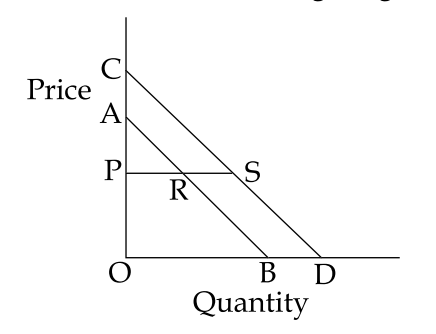
The price elasticity of demand at :
The question involves understanding the concept of price elasticity of demand along two parallel demand curves AB and CD. To solve this problem, let's consider the underlying principles of elasticity and how they apply to parallel demand curves.
Concept: The price elasticity of demand is a measure of how much the quantity demanded of a good responds to a change in the price of that good. It is mathematically represented as:
\(E_d = \left(\frac{\Delta Q}{Q}\right) \div \left(\frac{\Delta P}{P}\right)\)
Here, the two key points on the diagram are point R on demand curve AB and point S on demand curve CD.
- The elasticity at a point on a linear demand curve varies along the curve. It is highest (infinite) at the vertical axis, unitary at the midpoint of the curve, and zero at the horizontal axis.
- Since AB and CD are parallel, they have the same slope. However, point R is to the left of point S, meaning R is at a higher price level and lower quantity demanded compared to S.
- Price elasticity is greater at higher price levels for linear demand curves. Thus, the elasticity at point R is greater than the elasticity at point S.
The correct answer is that the price elasticity of demand at point R is greater than that at point S. This is because point R lies on a higher price and lower quantity compared to point S on their respective parallel demand curves.
Important Questions from Economics
RBI The sale of a bond by the United States to individuals or institutions results in a ______.
I. Shortage of stock
II. Shortage in money supply
The persistent and appreciable full in level of prices and when the rate of change of price index is negative it is called as
Hindustan Fluorocarbons Ltd (HFL) is subsidiary company of _______.
All those private sector establishments and the public sector establishments that employ 10 or more hired workers are called:
Situation when it becomes a burden for the lender to repay the loan and needs to borrower a new loan to pay the existing is called ______.


