
$$F(P, Q) = (\bar{P} + Q) \oplus (\bar{P}Q)$$
Which of the following expressions is/are equivalent to $F$ ?
Boolean Expression Analysis
We need to find the expressions equivalent to the given Boolean function:
$F(P, Q) = (\bar{P} + Q) \oplus (\bar{P}Q)$
Simplifying the Expression F
We simplify $F$ using algebraic manipulation:
- Let $A = \bar{P} + Q$ and $B = \bar{P}Q$. The expression is $F = A \oplus B$.
- Use the XOR definition: $X \oplus Y = X\bar{Y} + \bar{X}Y$.
- Calculate the complements $\bar{A}$ and $\bar{B}$:
- $\bar{A} = \overline{(\bar{P} + Q)} = \overline{\bar{P}}\overline{Q} = P\bar{Q}$ (Using De Morgan's Law).
- $\bar{B} = \overline{(\bar{P}Q)} = \overline{\bar{P}} + \bar{Q} = P + \bar{Q}$ (Using De Morgan's Law).
- Substitute back into the XOR formula: $F = (\bar{P} + Q)(P + \bar{Q}) + (P\bar{Q})(\bar{P}Q)$
- Expand and simplify the terms:
- First term: $(\bar{P} + Q)(P + \bar{Q}) = \bar{P}P + \bar{P}\bar{Q} + QP + Q\bar{Q} = 0 + \bar{P}\bar{Q} + PQ + 0 = PQ + \bar{P}\bar{Q}$.
- Second term: $(P\bar{Q})(\bar{P}Q) = P\bar{P}\bar{Q}Q = 0$.
- Combine the results: $F = (PQ + \bar{P}\bar{Q}) + 0 = PQ + \bar{P}\bar{Q}$.
The simplified expression for $F$ is $PQ + \bar{P}\bar{Q}$, which is the expression for XNOR.
Evaluating Equivalent Options
We check which options are equivalent to $PQ + \bar{P}\bar{Q}$:
- Option 1: $\overline{P \oplus Q}$
This is the definition of XNOR, equivalent to $PQ + \bar{P}\bar{Q}$. It matches $F$.
- Option 2: $P \oplus Q$
This is XOR, equivalent to $PQ + \bar{P}Q$. It does not match $F$.
- Option 3: $\bar{P} \oplus Q$
Algebraically: $\bar{P} \oplus Q = (\bar{P})\overline{Q} + \overline{(\bar{P})}Q = \bar{P}\bar{Q} + PQ$. This matches $F$.
- Option 4: $\bar{P} \oplus \bar{Q}$
Algebraically: $\bar{P} \oplus \bar{Q} = (\bar{P})\overline{(\bar{Q})} + \overline{(\bar{P})}\bar{Q} = \bar{P}Q + P\bar{Q}$. It does not match $F$.
Verification with Truth Table
A truth table confirms the equivalences:
| P | Q | $\bar{P}$ | $\bar{P} + Q$ | $\bar{P}Q$ | $F = (\bar{P}+Q) \oplus (\bar{P}Q)$ | Option 1: $\overline{P \oplus Q}$ | Option 3: $\bar{P} \oplus Q$ |
| 0 | 0 | 1 | 1 | 0 | 1 | 1 | 1 |
| 0 | 1 | 1 | 1 | 1 | 0 | 0 | 0 |
| 1 | 0 | 0 | 0 | 0 | 0 | 0 | 0 |
| 1 | 1 | 0 | 1 | 0 | 1 | 1 | 1 |
The output columns for $F$, Option 1, and Option 3 are identical, confirming their equivalence.
Final Answer Determination
The expressions equivalent to $F(P, Q)$ are Option 1 ($\overline{P \oplus Q}$) and Option 3 ($\bar{P} \oplus Q$).
Important Questions from Logic Gates and Boolean Algebra
The digital circuit shown has 3 inputs ($x$, $y$, and $z$).
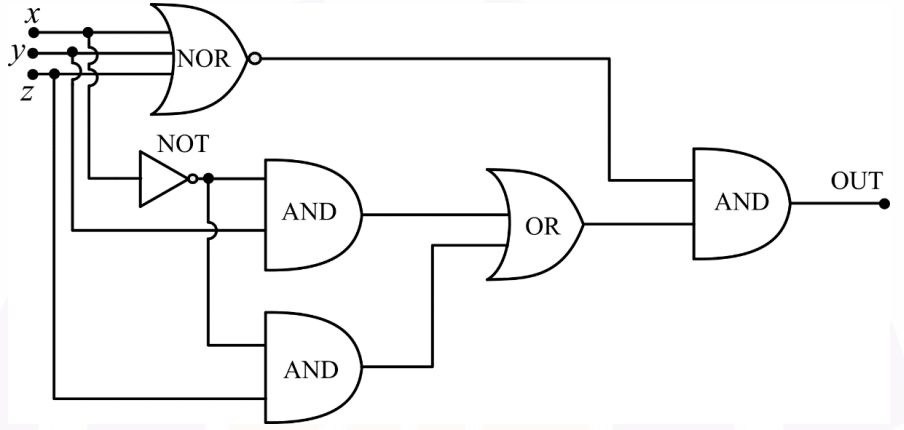
The simplified logical expression for the output (OUT) is:
The MOSFET switches shown in the circuit are ideal.
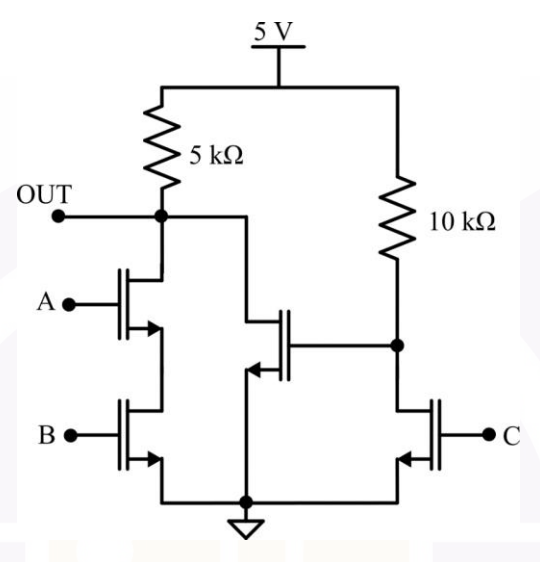
Which of the following is the correct option for Boolean logical expression of the output (OUT), and the maximum possible power (P) consumed by the circuit?
The Boolean expression \(AC+B\bar{C}\) is equivalent to :
Consider the following expressions :
(a) Y = f(A, B, C, D) = Σ (1, 2, 4, 7, 8, 11, 13, 14)
(b) Y = f(A, B, C, D) = Σ (3, 5, 7, 10, 11, 12, 13, 14)
(c) Y = f(A, B, C, D) = Π (0, 3, 5, 6, 9, 10, 12, 15)
(d) Y = f(A, B, C, D) = Π (0, 1, 2, 4, 5, 8, 9, 15)Which of the above expressions are equivalent to the expression Y = A⊕B⊕C⊕D ?
- Match the Exclusive-OR (XOR) operations (i) to (iv) with the results (p) to (s), where X is a Boolean input.
(i) $X \oplus X$ (p) 1 (ii) $X \oplus \bar{X}$ (q) 0 (iii) $X \oplus 0$ (r) $\bar{X}$ (iv) $X \oplus 1$ (s) X


