
Consider the cube shown below with its 8 corners labelled a, b, c, d, e, f, g, and h. The figure is representative. All corners are to be colored such that any two corners that are connected by an edge must be of different colors. The minimum number of colors required to achieve this is ________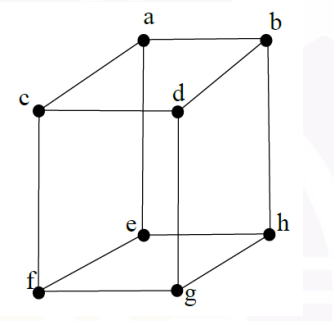
To solve this problem, we need to color the vertices (corners) of a cube such that no two adjacent vertices (connected by an edge) have the same color. This problem can be understood as a graph coloring problem where each vertex of the cube is a node, and each edge is a connection between these nodes.
A cube has 8 vertices and 12 edges. The goal is to use the minimum number of colors following the rule that no two directly connected vertices share the same color.
Step-by-step Solution:
- The cube is a bipartite graph. A graph is bipartite if its vertex set can be divided into two disjoint sets such that every edge connects a vertex in one set to a vertex in the other set.
- In a cube, each vertex is connected only to vertices in the opposite set. So, the graph is bipartite and can be colored using 2 colors.
- Color the vertices of one face of the cube alternately using two colors (say Color 1 and Color 2). Repeat the pattern on the opposite face.
- For example, color vertices a, e, g, and c with Color 1 and vertices b, f, h, and d with Color 2.
Thus, the minimum number of colors required is 2. This solution ensures that no two connected vertices have the same color.
Important Questions from Colouring
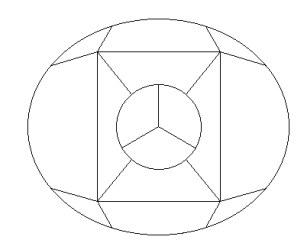
The 15 parts of the given figure are to be painted such that no two adjacent parts with shared boundaries (excluding corners) have the same color. The minimum number of colors required is
- An undirected, unweighted, simple graph $G(V, E)$ is said to be 2-colorable if there exists a function $c: V \rightarrow \{0, 1\}$ such that for every $(u, v) \in E$, $c(u) \neq c(v)$.
Which of the following statements about 2-colorable graphs is/are true?


