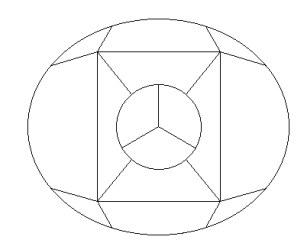
Which of the following statements about 2-colorable graphs is/are true?
Understanding 2-Colorable Graphs
A graph is 2-colorable if its vertices can be assigned one of two colors (e.g., 0 or 1) such that no two adjacent vertices share the same color. This property is equivalent to the graph being bipartite.
Analyzing Statements on 2-Colorability
Statement 1: Odd Cycles
Statement: If $G$ is 2-colorable, then $G$ may contain cycles of odd length.
Analysis: This statement is False. A graph is 2-colorable if and only if it contains no cycles of odd length. The presence of an odd-length cycle necessitates at least three colors, thus preventing 2-colorability.
Statement 2: Even Cycles
Statement: If $G$ is 2-colorable, then $G$ may contain cycles of even length.
Analysis: This statement is True. The condition for 2-colorability only prohibits odd cycles. Even-length cycles are permissible. For instance, a cycle graph $C_4$ (a square) is 2-colorable, having an even cycle of length 4.
Statement 3: Optimal Algorithm Time Complexity
Statement: An optimal algorithm for testing whether $G$ is 2-colorable runs in time $\Theta(|V| + |E|)$, if $G$ is represented as an adjacency list.
Analysis: This statement is True. Testing for 2-colorability involves checking for bipartiteness. Algorithms like Breadth-First Search (BFS) or Depth-First Search (DFS) can perform this check. Using an adjacency list representation, these traversal algorithms run in $\Theta(|V| + |E|)$ time, which is optimal as it requires examining all vertices and edges in the worst case.
Statement 4: Incorrect Algorithm Time Complexity
Statement: An optimal algorithm for testing whether $G$ is 2-colorable runs in time $\Theta(|E| \log|V|)$, if $G$ is represented as an adjacency list.
Analysis: This statement is False. The optimal time complexity for testing 2-colorability with an adjacency list is $\Theta(|V| + |E|)$, not $\Theta(|E| \log|V|)$.
Conclusion
Statements 2 and 3 are true regarding 2-colorable graphs.
Important Questions from Colouring
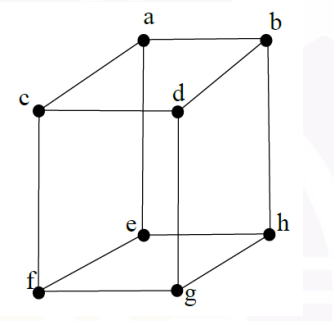
Consider the cube shown below with its 8 corners labelled a, b, c, d, e, f, g, and h. The figure is representative. All corners are to be colored such that any two corners that are connected by an edge must be of different colors. The minimum number of colors required to achieve this is ________
The 15 parts of the given figure are to be painted such that no two adjacent parts with shared boundaries (excluding corners) have the same color. The minimum number of colors required is